


Good morning.
I’m Mitsui, a web3 researcher.
Today I researched “Sponge.”
What is Sponge?
Transition and Outlook
The shift toward an agent economy is progressing
TL;DR
Sponge is a financial infrastructure enabling AI agents to hold and disburse funds without human intervention, aiming to realize an agent economy.
With “Sponge Wallet” and “Sponge Gateway,” agents can autonomously handle everything from paying service fees and sending money to making investment decisions, while businesses can receive payments directly from agents.
A founding team from Stripe launched in 2026 through Y Combinator and is gaining attention as the next-generation automated economic infrastructure powered by AI and blockchain.
What is Sponge?
Sponge is a startup that provides financial infrastructure enabling AI agents to hold and spend money without human intervention.
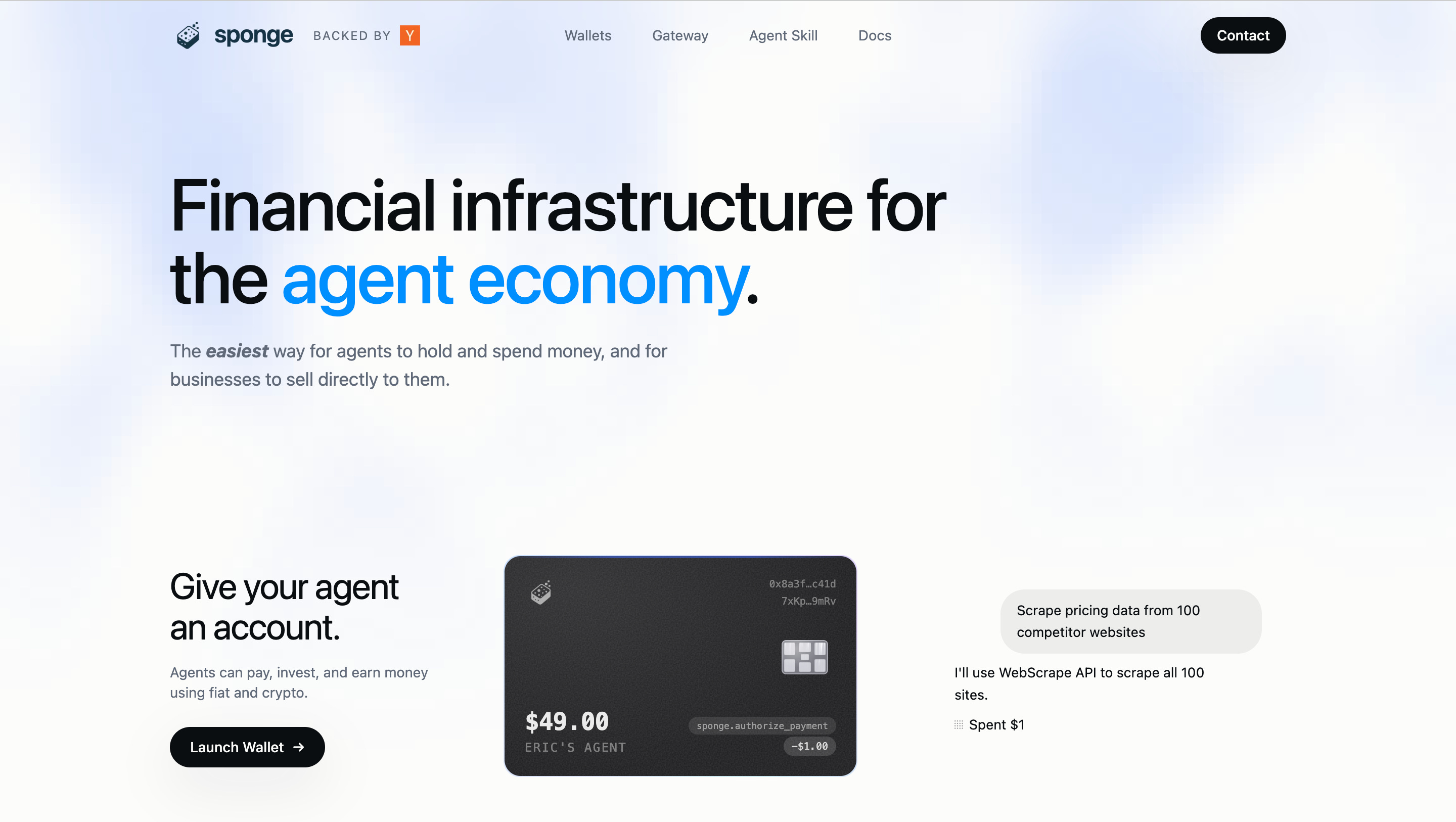
Advances in AI agent technology are making it increasingly feasible for AI to autonomously perform tasks over extended periods, but a challenge remains: human intervention is still required during the payment processing stage.
Sponge provides a platform enabling AI agents themselves to complete payments.
For example, AI agents will be able to pay for web service usage fees and transfer funds to other agents without human intervention. As a result, economic activities between agents and between agents and services will be realized without manual input or API key sharing, enabling autonomous business models driven by agents.
◼️Products Offered
The primary products we offer are broadly categorized into two: “Sponge Wallet” (for agents) and “Sponge Gateway” (for businesses).
Sponge Wallet
We provide wallet accounts that enable users to deposit funds and make payments to AI agents without human intervention.
Agents can hold fiat currency and cryptocurrency through this wallet and autonomously execute payments, transfers, and investments as needed.
Once a person deposits the required amount into the wallet, the agent can then use those funds at their own discretion to purchase services and other items.
For example, a series of processes such as “using $5 worth of funds in the wallet to purchase necessary API data, and then executing stock trades” can be completed entirely by agents without human intervention.

Sponge Gateway
We provide a platform for businesses and service providers to accept direct payments from AI agents.
Specifically, providers can automate agent onboarding and payment acceptance simply by uploading their service’s API specification (such as OpenAPI).
Whereas previously human users would have to enter credit card information or API keys, using the Gateway allows agents themselves to complete everything from service contracts to payments with just a few clicks, eliminating the need for human intervention or code modifications. In other words, it’s like providing an “agent-friendly online payment gateway.”
This enables service providers to tap into a new customer base of AI agents, and in the future, generate revenue from these agents just as they do from human users.
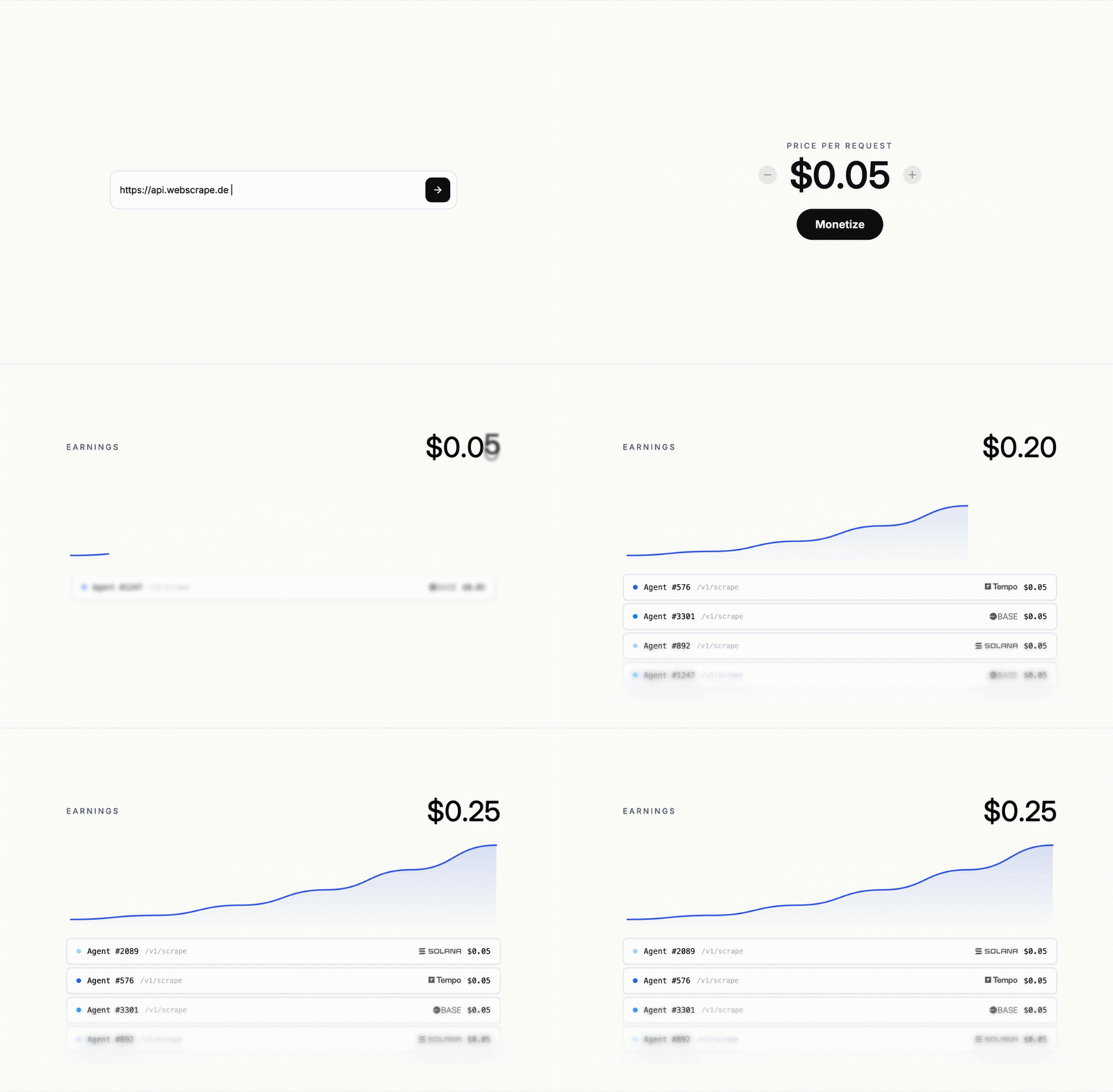
Based on these two foundations, Paysponge enables a wide range of use cases.
◼️Use Cases
Examples provided on the official website include the following use cases:
Data Purchase and Investment Decisions
Suppose an agent autonomously trading stocks purchases external data (e.g., corporate financial reports) before executing trades. Using Sponge Wallet, the agent can independently purchase the 10-K annual report from a paid API and consistently execute the decision and trade based on the collected financial data, such as “Buy 10 shares of Acme stock if revenue growth exceeds 50%.” This entire process requires no human intervention whatsoever; the agent handles everything from the small payment required for data purchase to placing the order via the securities API.Service fee remittance and settlement
This refers to cases where agents transfer compensation or fees to other agents or to human service providers. For example, consider a scenario where an agent outsources design work to another party (a person or agent) and pays them $150 as compensation. The agent executes a command from Sponge Wallet to send the equivalent of $150 to the recipient, and Sponge’s system securely processes this. At this point, details such as the initiation of the transaction and the amount are automatically logged and can be tracked via the audit functionality described later.Expenditure Management and Control
If you’re hesitant about granting agents full financial authority, you can set guardrails to limit budgets and spending destinations. Sponge’s wallet features include controls such as budget caps (e.g., up to $X per day, up to $X per transaction) and whitelist settings for permitted domains/APIs. For example: “Up to $25 per day, under $5 per transaction, and permitted domains are...”ai-assist.devとdata-api.devとwebscrape.devBy defining rules such as “limited to drinking only,” agents can only spend funds within that scope. This prevents runaway spending and misuse while still granting agents a degree of financial discretion.
As described above, Paysponge is a platform that supports a wide range of use cases, from agents making small-value service purchases and remittances to full-scale commercial transactions.
By utilizing this infrastructure, it is anticipated that agents will eventually autonomously buy and sell services among themselves, forming automated transactions via APIs on the web (the so-called Machine-to-Machine economy).
Transition and Outlook
Sponge is a startup founded in 2026 and a company accepted into the Y Combinator Winter 2026 batch.
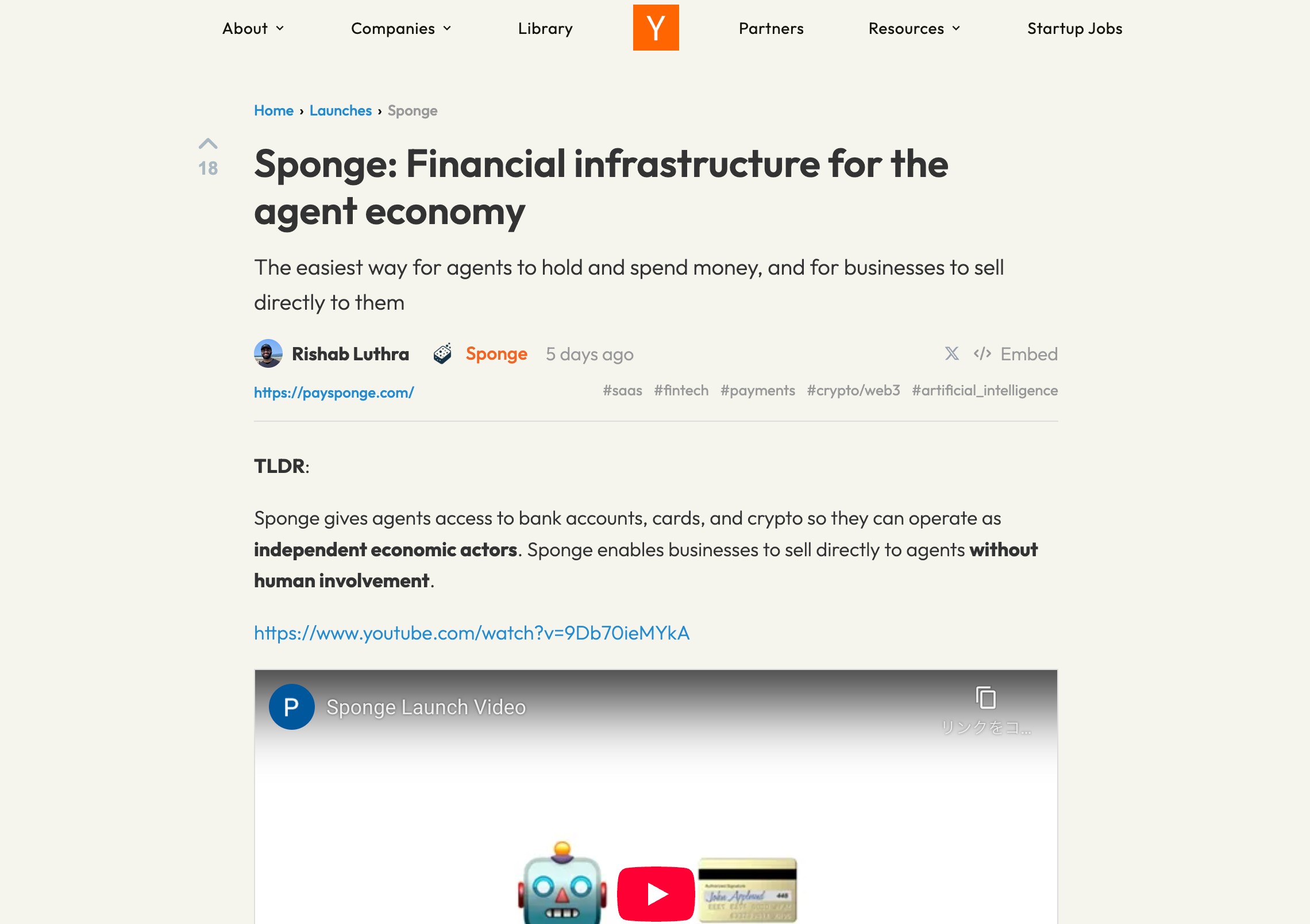
The three founders are all engineers formerly of Stripe, with backgrounds leading cryptocurrency-related projects at the company. Their profiles are as follows:
Jae Choi
Co-founder of Sponge. Earned a degree in Computer Science from the University of Waterloo in 2019. At Stripe, he worked on developing the core payment system and contributed to launching the company’s first cryptocurrency product.Rishab Luthra
Co-founder of Sponge. After earning a Bachelor of Science in Computer Science from the University of Toronto in 2022, he joined Stripe, working as a software engineer in the cryptocurrency division. During his studies, he interned as a software engineer at Facebook (2021) and Google (2020), and also held development roles at other startups.Eric Zhang
Co-founder of Sponge. An engineer who led the development of financial accounts and payment systems using stablecoins within Stripe’s cryptocurrency team.
The impetus for founding the company was the growing demand for autonomous payments enabled by AI agents.
In recent years, long-running agents like AutoGPT have emerged, enabling them to perform complex tasks without human intervention. However, when payments are involved, agents cannot process transactions independently; humans must input credit card information and approve the payment, hindering automation.
To solve this problem, the founding team leveraged their expertise gained at Stripe to embark on building financial infrastructure for the gig economy.
Co-founder Jae Choi himself stated, “We are currently building Sponge to provide wallets for agents,” with the vision of granting agents human-like financial transaction capabilities.
As it has only just been released, the published use cases are limited, but some startups are already moving forward with trial implementations.
AgentMail
AgentMail is a service that provides AI agents with their own email addresses and inboxes, and is a company born from the Y Combinator Summer 2025 batch. While developers typically pay usage fees with a credit card for this service, combining it with Paysponge Gateway allows The agent themselves enters into a mailbox usage agreement and makes payments.This has now become possible. As a concrete benefit, AgentMail can automatically onboard new users (i.e., AI agents) without human intervention, enabling it to increase its customer base (agents) 24/7, 365 days a year. Furthermore, fee collection is automated, reducing the risk of non-payment and cutting operational costs. For agent developers, there is also the benefit of being able to connect their agents to AgentMail more easily. The AgentMail team commented, “The payment aspect, which was the biggest concern in providing mailboxes, was resolved with the introduction of Sponge,” indicating that it effectively removed an uncertainty factor in service provision.Steel
Steel is an open-source browser automation API and a platform for managing and providing multiple browser sessions in the cloud. It is used for AI agents performing web browsing and scraping tasks. Paid plans enable numerous concurrent sessions and extended runtime. Steel has also implemented Sponge to test agent-initiated usage requests and payment acceptance. This enables a fully autonomous workflow where, for example, an agent can independently sign up to Steel, secure a browser operation environment, automatically pay usage fees, and execute tasks (such as web data collection).
Additionally, while specific names have not been disclosed, the Sponge team states that “multiple teams have already begun using Sponge for agent onboarding and payment acceptance.”
Additionally, a beta pilot has recently been launched where agents make purchases on Amazon. This initiative allows agents to complete shopping on Amazon as needed, provided users have pre-linked their Amazon accounts to their wallets.


Sponge is being trialed across various front lines of agent utilization, and its effects—reducing labor costs, expanding new automation scope, and demonstrating the agent economy—are gradually being reported.
The transition to an agent economy is advancing
Finally, we come to the summary and analysis.
Lately, I’ve been researching many AI agent-related projects. While part of this stems from my personal interest, investigating trending projects also reveals an industry-wide trend: this field is seeing significant concentration.
AI agents combined with financial infrastructure are poised to become the next hot trend. Numerous startups are emerging that use blockchain to remove payment barriers—a key challenge when AI agents perform tasks—and their widespread adoption is something to look forward to.
Moreover, this excitement isn’t confined to the crypto space—it’s sweeping the entire AI and startup industries. Given that Sponge is a recent Y Combinator graduate, it’s no exaggeration to say its business reflects the current startup trends.


I’ve been experimenting with various AI technologies myself, and since they seem to pair well with blockchain, I’d like to explore what I can create within my capabilities. Smart contracts are still a bit intimidating, and I’m hesitant about my main goals of asset management and trading. So, I’m thinking of starting with small-scale trading or simply using various services through AI as an initial experience.
We’re also thinking about hosting events like hands-on workshops in this area, so please look forward to them. I’m excited to see the intersection of AI and blockchain continue to expand.
That concludes our research on “Sponge”!
Reference Links:HP / X
Disclaimer:I carefully examine and write the information that I research, but since it is personally operated and there are many parts with English sources, there may be some paraphrasing or incorrect information. Please understand. Also, there may be introductions of Dapps, NFTs, and tokens in the articles, but there is absolutely no solicitation purpose. Please purchase and use them at your own risk.
About us
🇯🇵🇺🇸🇰🇷🇨🇳🇪🇸 The English version of the web3 newsletter, which is available in 5 languages. Based on the concept of ``Learn more about web3 in 5 minutes a day,’‘ we deliver research articles five times a week, including explanations of popular web3 trends, project explanations, and introductions to the latest news.
Author
mitsui
A web3 researcher. Operating the newsletter “web3 Research” delivered in five languages around the world.
Contact
The author is a web3 researcher based in Japan. If you have a project that is interested in expanding to Japan, please contact the following:
Telegram:@mitsui0x
*Please note that this newsletter translates articles that are originally in Japanese. There may be translation mistakes such as mistranslations or paraphrasing, so please understand in advance.