


Good morning.
I’m Mitsui, a web3 researcher.
Today I researched Saturn.
What is Saturn?
Transition and Future Outlook
The on-chain migration of off-chain financial products is progressing.
TL;DR
Saturn is a Bitcoin credit-backed stablecoin protocol that offers the USDat stablecoin, backed by US Treasury securities, and the sUSDat stablecoin, which generates yields backed by Bitcoin Credit (MicroStrategy’s STRC).
BTC → MicroStrategy (BTC treasury company) → Preferred stock STRC → sUSDat This chain of trust enables the on-chain tokenization of Bitcoin’s value as “digital credit,” which is its defining feature.
Initially launched with USDat = 100% U.S. Treasury bond collateral and sUSDat = 100% Bitcoin Credit collateral, USDat itself will increase its Bitcoin Credit ratio in the future, aiming to become a reserve currency providing a sustainable yield of 10% or more.
What is Saturn?
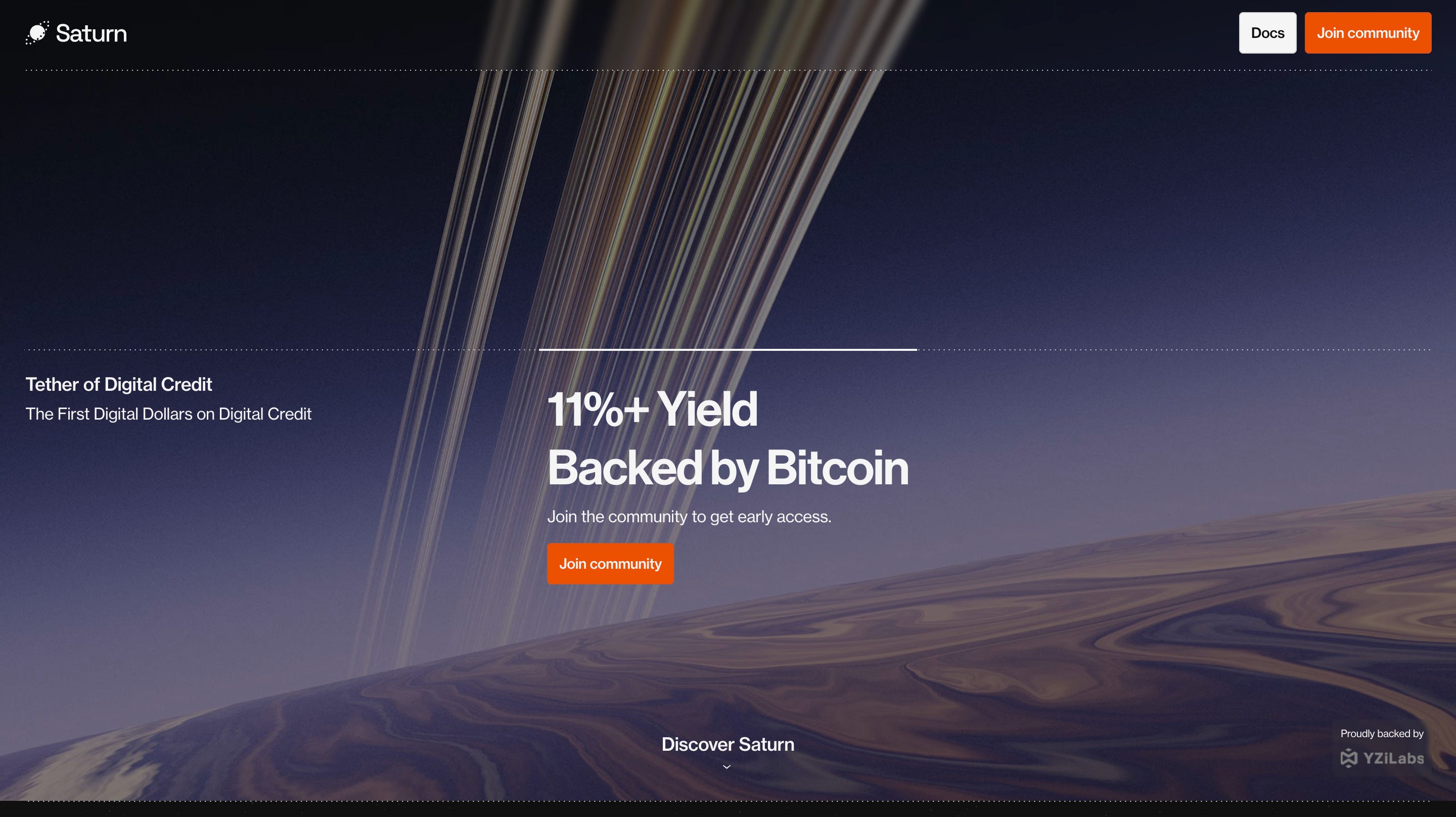
“Saturn” is,High-Yield Stablecoin Protocol Leveraging BitcoinThis is a project to develop [the product/service].
Specifically, a stablecoin pegged to the U.S. dollar “USDatand the staking version where you can earn yieldssUSDatis issuing a new reserve currency backed by Bitcoin.
◼️The challenge we are trying to solve
The Saturn team recognizes the following current challenges:
Bitcoin price fluctuations
Bitcoin excels as a store of value, but its price volatility makes it unsuitable for everyday payments and mass adoption. We need to reduce Bitcoin’s volatility and create a stable form for consistent use.The Lack of Yield in DeFi
In the current DeFi landscape, there is a shortage of stable, scalable, and sustainable yield-generating solutions. Existing yield sources, such as liquidity mining and lending, suffer from high volatility and scalability issues, making it difficult to expand their scale.Opacity of Credit Assets
Traditional credit products (such as corporate bonds and loans) are black-boxed and lack transparency, with trust relying on central entities like banks. There is a demand for transparent credit systems built on-chain.
◼️Saturn Solutions
To address the above challenges, Saturn aims to resolve them by issuing a stablecoin backed by a hybrid reserve consisting of tokenized government bonds and Bitcoin-collateralized assets, known as “USDat.”
Specifically, we aim to create the world’s first “Bitcoin-native reserve currency” that achieves both price stability and sustainable interest. This is accomplished by combining the stability and liquidity of U.S. Treasury Bills (tokenized) with the yield generated from Bitcoin-backed credit assets (Bitcoin Credit).
This design converts Bitcoin’s immense value into a “digital credit” layer for credit creation, enabling the global provision of yields exceeding 10% per annum while ensuring transparency and stability.
It might be a bit hard to grasp, but looking at specific products should help you understand better.
◼️Products Offered
Specifically, we primarily offer the following two types of tokens.
USDat
It is a fiat-backed stablecoin like USDC. At issuance, the reserve composition is 100% backed by U.S. Treasury bonds, prioritizing value stability and liquidity assurance.sUSDat
sUSDat is the token received by staking USDat. sUSDat is backed by Bitcoin Credit, and the interest generated from it accumulates through compounding.
The key point is “Bitcoin Credit.”
This is a credit product utilizing Bitcoin’s creditworthiness.
Saturn uses STRC (Stretch), a credit product issued by MicroStrategy, as collateral for sUSDat.
STRC is known as Perpetual Preferred stock, a type of preferred stock with no maturity date. Its most significant feature is thatDividends are paid monthly, and the dividend rate is also reviewed monthly.at the point.
As a preferred stock, it is a security listed on the U.S. securities market (NASDAQ), and can be bought, sold, and held through a securities account. Therefore, STRC itself also has a stock price.
This stock price is influenced by the performance of the issuer, MicroStrategy, and the price of BTC, but the monthly dividend amount is the most significant factor. Simply put, a dividend yield of 10%, 5%, or 20% directly impacts supply and demand.
STRC is designed to maintain its stock price around $100 by adjusting its dividend payout ratio monthly. In other words, it’s structured to deliver stable yields rather than capital gains from the stock itself.
Incidentally, MicroStrategy has designed numerous other preferred stock classes, allowing investors to purchase them according to their own risk tolerance.
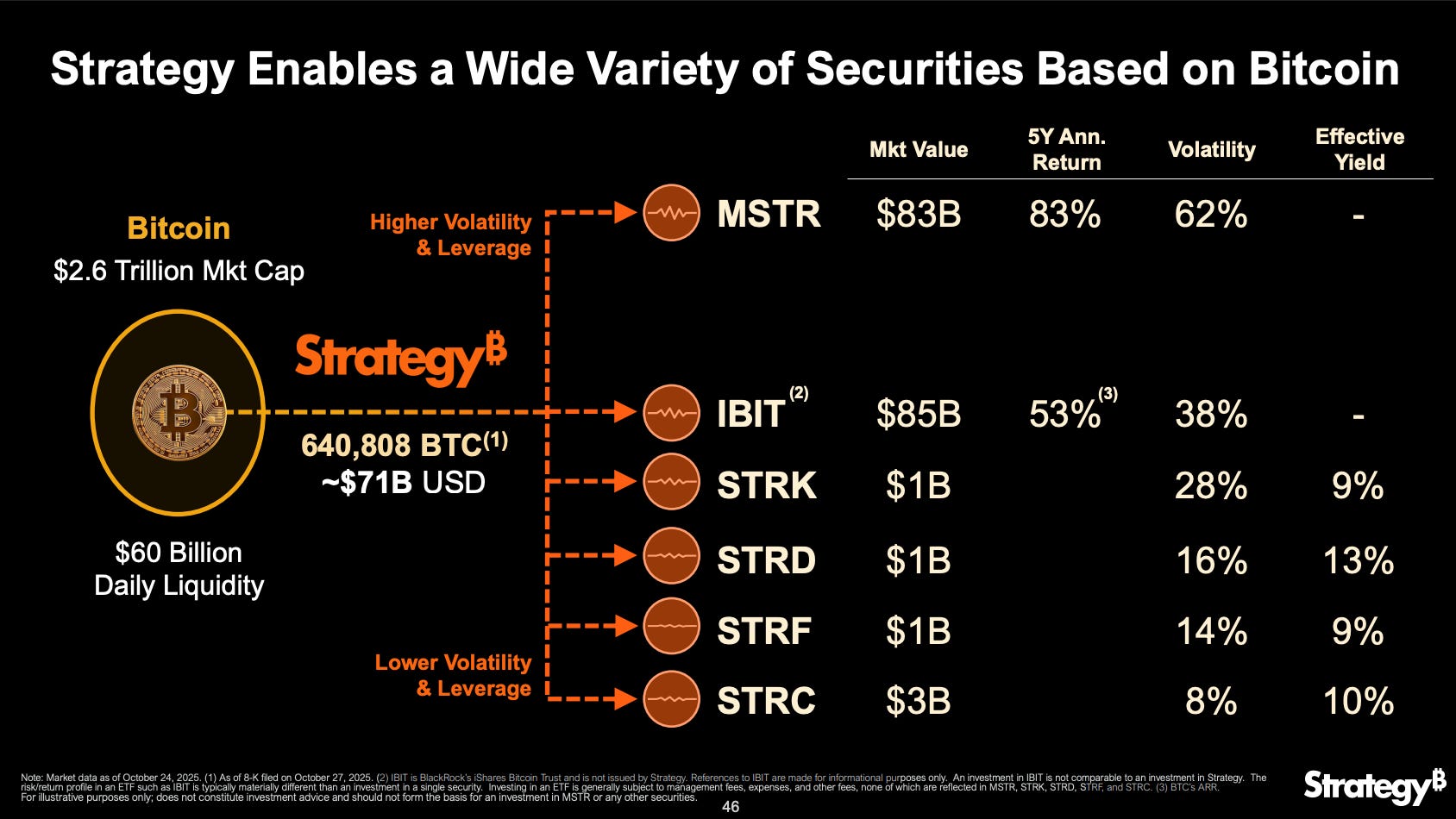
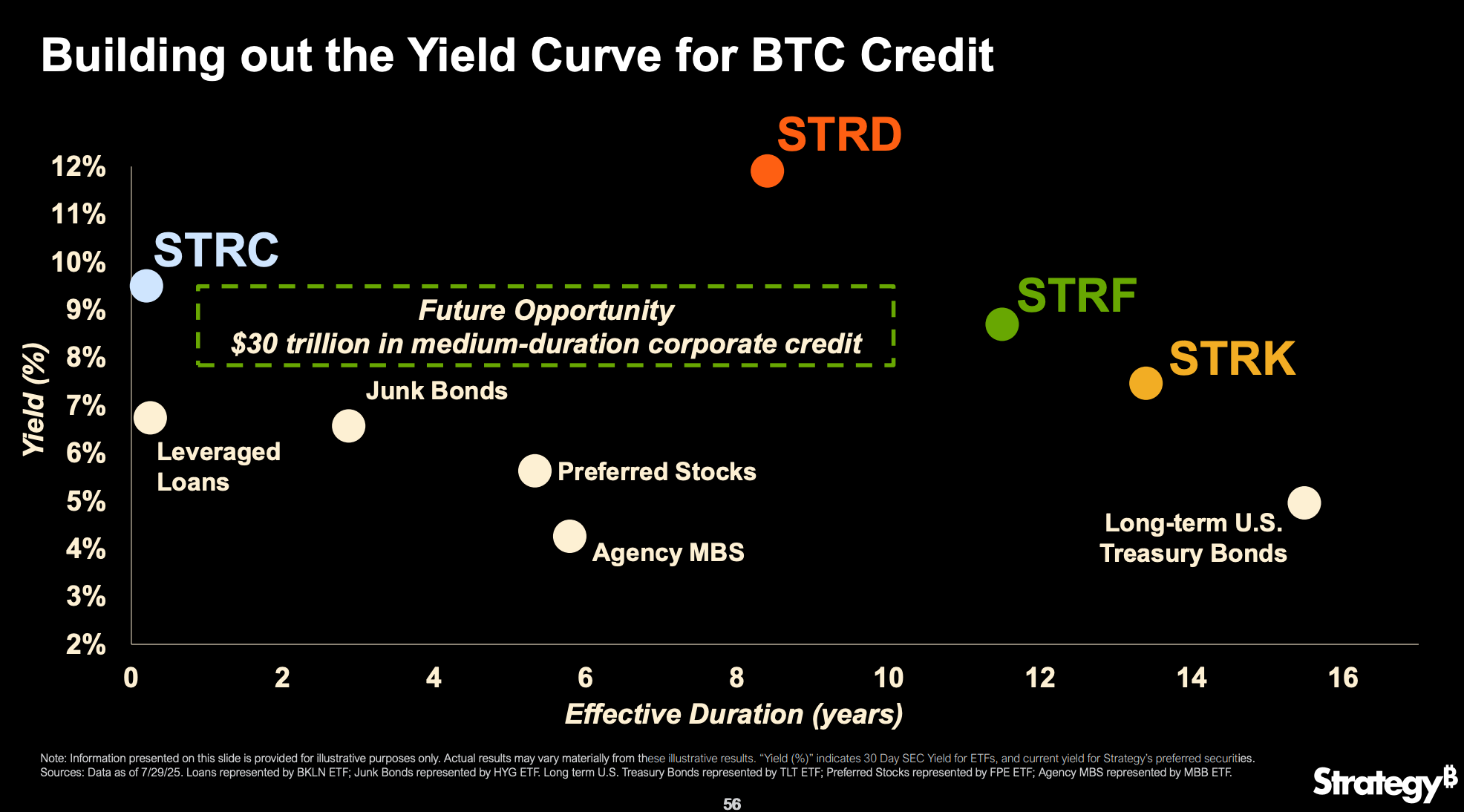
Let me organize it.
USDat:Saturn’s US Treasury-backed stablecoin. No yield.
sUSDat:Tokens earned by staking USDat. Secured by STRC, with operational profits returned to holders.
STRCMicroStrategy’s perpetual preferred stock. Its key feature is the monthly adjustment of the rate to maintain the stock price around $100.
MicroStrategyThe world’s largest Bitcoin treasury company.
In other words, MicroStrategy is a company that continuously buys BTC, so its stock price is proportional to the BTC serving as its actual collateral. Furthermore, it issues preferred stock using the credibility of that stock price as collateral, meaning products like STRC are effectively backed by the creditworthiness of BTC. And sUSDat is a token collateralized by STRC.
Therefore, the flow is BTC > MSTR (MicroStrategy stock) > STRC > sUSDat. Saturn claims to be issuing tokens backed by Bitcoin Credit, the world’s first credit product leveraging Bitcoin’s credit.
Incidentally, I believe the “Dat” in USDat stands for Digital Asset Treasury. Since it’s USD backed by DAT companies, it’s called USDat.
Additionally, while USDat was described as being backed by U.S. Treasury bonds, this refers to the initial release. The plan is to eventually transition the collateral for this pure stablecoin to Bitcoin Credit. For example, it will start with a ratio like 90% U.S. Treasury bonds and 10% Bitcoin Credit, ultimately aiming for a stablecoin USDat fully collateralized by Bitcoin Credit (100%), along with sUSDat that provides access to its yield.
However, initially, it is positioned as USDat, backed 100% by U.S. Treasury bonds, and sUSDat, backed 100% by Bitcoin Credit. When staking USDat, the process involves selling the Treasury bonds that served as collateral and purchasing Bitcoin Credit to use as collateral. The same applies when unstaking.
Transition and Future Outlook
Saturn Labs was founded in 2025 and began developing the high-yield stablecoin USDat. The team consists entirely of University of Pennsylvania alumni, with the three key members being:
Kevin Li (Co-founder and CEO)
I served as a Researcher at ParaFi Capital and previously worked as a Data Lead at Artemis (a blockchain data analytics firm), where I was involved in reserve analysis for digital assets and the development of on-chain services for stablecoins.Sebastian “Seb” Melendez (Co-founder and CTO)
As the lead for the stablecoin division at Artemis, I have experience spearheading technological development and possess expertise in smart contract development and asset management technologies on the blockchain.Ellis Osborn (Co-founder and COO)
I served as the president of Penn Blockchain, the blockchain club at the University of Pennsylvania, and worked at venture capital fund M31 Capital as a crypto asset investment manager.
Regarding funding, we announced an $800k angel round in January 2026. Since the Saturn project has received investment and incubation support from YZi Labs since its early development stages, this includes $500k from YZi Labs plus $300k from the angel round led by Sora Ventures.
Additionally, several prominent angel investors participated in this round, including industry luminaries such as Luca Netz, CEO of Pudgy Penguins; DeFi influencer DeFi Dad; and Anthony Yim, formerly of Coinbase.

As of January 2026, USDat and sUSDat have not yet been officially issued on a public mainnet, but preparations for their launch are underway.
The on-chain migration of off-chain financial products is progressing
Finally, we conclude with a summary and analysis.
This is a very interesting project. The revolution advocated by DAT, including companies like MicroStrategy, involves a funding model using existing financial instruments like stocks and bonds alongside a BTC holding model. Saturn takes that model and brings it back on-chain.
It’s said that we’re entering an era where everything will be tokenized, but I think it will take some time for all the infrastructure that traditional financial institutions have built up to migrate on-chain. For example, if bonds and stocks could be issued on-chain from the outset, there would be no need for oracles, nor would there be a need for off-chain custody.
However, this involves legal amendments, which will take time, and there may also be risks associated with full on-chain solutions that are not yet apparent.
Recently, a trend has emerged where off-chain assets—accessible only to certain individuals in specific regions—are purchased, and tokens backed by these assets are circulated on-chain. Even if only KYC-compliant entities can issue and redeem these tokens on-chain, subsequent trading occurs freely via DeFi. This effectively liberates the assets from geographical and human constraints, making them composable.
This is also true for the Bitcoin Credit from MicroStrategy that Saturn is working on. By issuing tokens backed by assets previously only purchasable by U.S. securities account holders and enabling access to their yields, anyone can indirectly gain exposure to Bitcoin Credit.
Incidentally, Saturn charges 10% of Bitcoin credit management profits as an operational fee, with the remaining 90% returned to token holders. This approach, which resembles custody revenue, involves wrapping all kinds of assets to create new on-chain financial products—a trend that seems poised to accelerate.
Issuers, wrappers, distributors, and others are branching out, and the world of composable finance enabled by DeFi’s interoperability is rapidly becoming a reality.
Well, naturally, as collaboration progresses, the risk of chain bankruptcies increases accordingly, so caution is necessary.
For now, I’ll wait for the USDat release and continue to follow the updates!
That concludes our research on “Saturn”!
Reference links:HP / BLOG / DOC / X
Disclaimer:I carefully examine and write the information that I research, but since it is personally operated and there are many parts with English sources, there may be some paraphrasing or incorrect information. Please understand. Also, there may be introductions of Dapps, NFTs, and tokens in the articles, but there is absolutely no solicitation purpose. Please purchase and use them at your own risk.
About us
🇯🇵🇺🇸🇰🇷🇨🇳🇪🇸 The English version of the web3 newsletter, which is available in 5 languages. Based on the concept of ``Learn more about web3 in 5 minutes a day,'' we deliver research articles five times a week, including explanations of popular web3 trends, project explanations, and introductions to the latest news.
Author
mitsui
A web3 researcher. Operating the newsletter "web3 Research" delivered in five languages around the world.
Contact
The author is a web3 researcher based in Japan. If you have a project that is interested in expanding to Japan, please contact the following:
Telegram:@mitsui0x
*Please note that this newsletter translates articles that are originally in Japanese. There may be translation mistakes such as mistranslations or paraphrasing, so please understand in advance.