

Good morning.
I’m Mitsui, a web3 researcher.
Today, under the title “The Collapse of InfoFi and New Developments,” we’ll explain the current situation of Kaito and Cookie.
InfoFi Collapse Due to X API Restrictions
Kaito’s response
Cookie Handling
Two Paths to Permissionless
On January 15, 2026, X will prohibit API access for InfoFi-related apps.Additionally, core features such as Kaito/Cookie were suspended due to increased spam.
Kaito pivoted from Yaps to Kaito Studio(Closed-loop model for certified creators × brands, expanding into multi-SNS and finance/AI domains), and further launching Polymarket and Attention Markets.
Cookie maintains its data infrastructure even after Snaps ceases operations, expanding into prediction markets with Cookie Pro and Chance.In summary, “free participation for anyone” is vulnerable to spam. Going forward, two practical approaches are “participant risk” or “participant restrictions.”
InfoFi Collapse Due to X API Restrictions
On January 15, 2026, Nikita Bier, Head of Product at X, suddenly announced, “We are banning all apps that pay for posts (so-called InfoFi) and immediately halting API access for related apps.”

Mr. Bier explained the reason, stating, “Such mechanisms are leading to a flood of meaningless AI-generated posts (commonly referred to as ‘AI slop’) and reply spam, damaging the platform’s user experience.”
In fact, as mentioned earlier, excessive posting incentives from InfoFi’s various services were causing increased noise on Twitter. Consequently, X Corporation took the drastic step of suspending access to its developer API as a fundamental solution.
This decision rendered InfoFi-related products such as Kaito and Cookie unable to retrieve post data or perform automated posting, effectively halting their core functionality.
Kaito’s Response
Just one hour after Bier’s announcement, Kaito Official (Yu Hu) declared on X that “Yaps” would be discontinued. Concurrently, they announced the closure of the incentive-based leaderboard previously running on X and the suspension of rewards through this feature for the time being.
Immediately after this announcement, the KAITO token price plummeted, temporarily falling to $0.57, down 17% from the previous day.
Additionally, in mid-January prior to the announcement, it was confirmed that some large KAITO token stakers had conducted abnormal unstaking (over 1 million tokens, 20 to 30 times the usual amount). This led to speculation within the community about insider trading by Company X and certain related parties. While Yu Hu denied any insider misconduct, the situation sparked distrust.
◼️Transitions to Date
Before moving forward, let’s briefly review the changes that have occurred up to this point.
Kaito was founded in 2022 by Yu Hu, a former Citadel quant. Starting as a crypto asset information platform combining data collection and AI analysis, it raised $5.3 million in a seed round and $5.5 million in a Series A round in 2023, securing a total of $10.8 million in funding. Investors included major VCs such as Dragonfly Capital, Sequoia China, Spartan Group, and Mirana, reflecting significant expectations for the potential of “InfoFi” – the concept of turning information itself into an asset.
Kaito initially launched “Yaps,” a user-participation information sharing platform, while simultaneously developing an information search engine and market data analysis tool (Kaito Pro) for the cryptocurrency sector.
Yaps provided a system where users could post and analyze cryptocurrency projects on X, earning rewards in the form of points and KAITO tokens based on the “quality” and “influence” of their content.
Kaito’s AI algorithm evaluates post content and engagement, distributing tokens to users who rank high on the public leaderboard, thereby realizing the “monetization of attention.”
This model enabled cryptocurrency projects to reward their communities directly instead of paying advertising agencies, aiming to create a new system where users could earn income by sharing valuable information.
This system gained popularity, and from 2024 to 2025, Kaito’s Yaps community experienced rapid growth.
According to publicly available information, by the end of 2025, the number of monthly active “Yappers” reached approximately 200,000. Through campaigns with multiple partner projects (including EigenLayer, Berachain, and Story Protocol), cumulative rewards worth approximately $116 million have been distributed to creators.
The market capitalization of KAITO tokens temporarily reached $2 billion in February 2025, demonstrating the market’s recognition of the potential of the InfoFi model.
However, behind this rapid growth, negative aspects such as an increase in low-quality posts created solely to earn rewards and spam issues caused by bots gradually became apparent.
By the latter half of 2025, spam replies and low-quality information on X became a serious problem as posts motivated by rewards increased.
On January 9, 2026, Jiho of crypto analytics firm CryptoQuant reported that “bots generated 7.75 million crypto-related posts in 24 hours,” a staggering 1224% increase compared to normal levels. In response to this situation, the Kaito team also began taking steps to mitigate spam.
According to Yu Hu, despite attempting various improvements—such as strengthening user screening, raising the leaderboard threshold to target only the top X% for rewards, implementing filtering based on social on-chain data, and fine-tuning the reward mechanism—a fundamental solution was not achieved.
This situation led to the aforementioned X API restrictions.
Kaito revealed in a statement that prior discussions had been held with Company X. According to Yu Hu, while exploring countermeasures for the spam issue, direct dialogue was also conducted with Company X. They reached a shared understanding that “a completely open, permissionless distribution system is no longer realistic and does not align with the needs of high-quality brands, serious creators, or the platform X itself.”
In other words, Kaito had also come to realize the limitations of the current InfoFi model and, after coordinating with X, had resolved to move on to the next step. Indeed, Yu Hu stated, “We had been developing relatively quietly for several months leading up to the announcement,” indicating that the swift announcement of Yaps’ termination was not a hasty, ad hoc response but a planned action for a foreseeable situation.
◼️New Chapter
Upon receiving notification of API suspension, Kaito announced the termination of Yaps and simultaneously declared a shift to a new strategy, “Kaito Studio.”
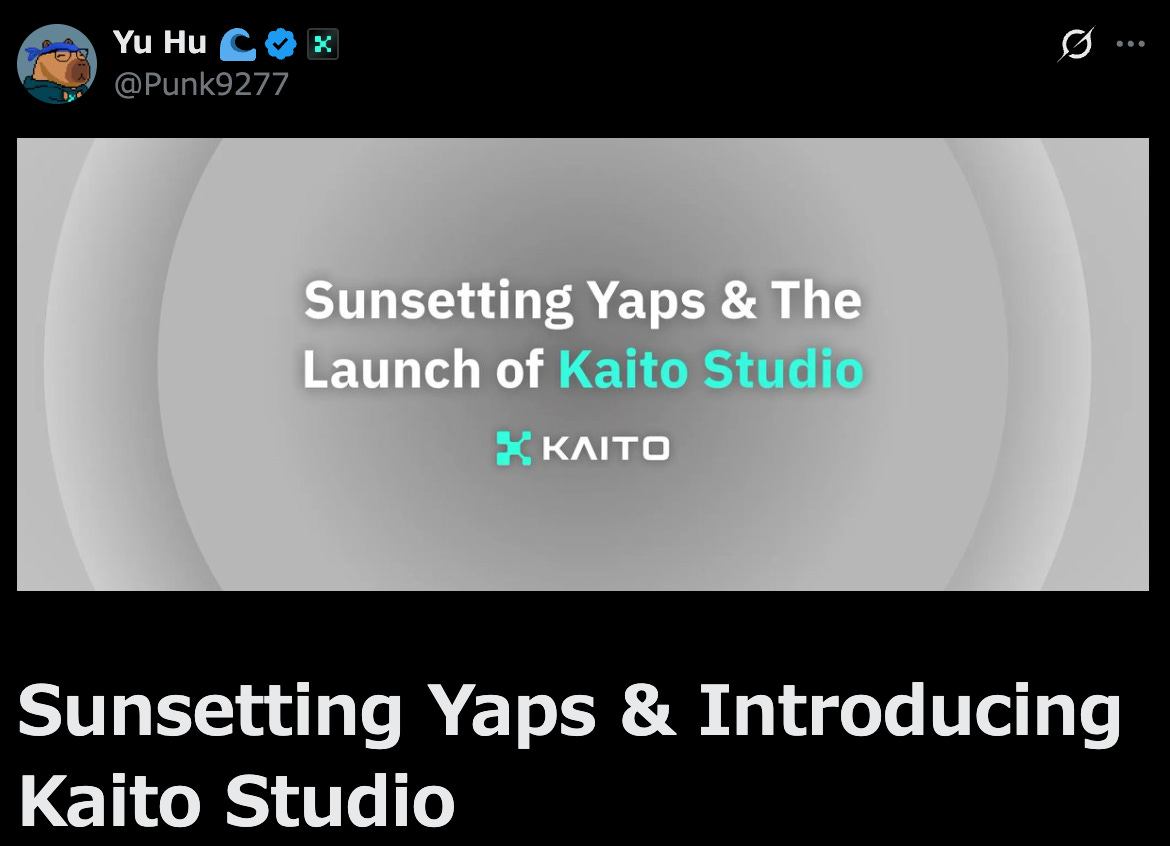
Kaito Studio will transition to a model where brand companies (projects) select creators who meet certain criteria, and provide compensation and collaboration opportunities for the information dissemination campaigns undertaken by those creators.
This decision marks a shift from the previous model where an unspecified number of creators freely posted and competed, toward a more closed, quality-focused marketing support business that matches certified creators—selected based on established criteria—with brands.
Additionally, the company announced it will expand its activities beyond X to other major social media platforms like YouTube, TikTok, and Instagram, and broaden its scope beyond the cryptocurrency sector to include adjacent and related fields such as finance and AI.
Yu Hu also stated that 2026 “will be the year Kaito moves beyond the crypto asset cluster (CT) as its primary arena, and crypto assets themselves cease to be the main focus.” Kaito aims to break free from being a niche service within the crypto community and become a platform spanning general corporate marketing and financial information fields.
The waiting list is currently open, and it appears the official launch is imminent.


◼️Expanding into prediction markets
Furthermore, on February 10, 2026, Kaito announced a partnership with Polymarket. Through this collaboration, the two companies will launch a new prediction market category called “Attention Markets.”

“Attention Markets” is an initiative that expands upon traditional binary prediction markets by quantifying and trading internet attention (mindshare) and sentiment.
Kaito collects and aggregates data from multiple social platforms such as X, TikTok, Instagram, and YouTube, providing technology that measures how much attention a topic is receiving (mindshare) and the positive/negative sentiment trends.
By utilizing this data as a settlement indicator for new markets on Polymarket, it is possible to create unique markets such as “Will Anthropic surpass OpenAI in popularity next month?” or “Will public opinion toward Elon Musk improve this month?”
In fact, markets such as “Anthropic vs. OpenAI popularity” are cited as examples, and this partnership enables the creation of markets targeting such cultural and public opinion topics.
Polymarket plans to launch dozens of these social data-driven markets by March 2026 and scale up to thousands by year-end. Initially, they will focus on topics within the AI industry (such as the aforementioned Anthropic vs. OpenAI debate), later expanding into various domains including entertainment and global news.
Kaito reportedly raised $10.5 million in funding to support this new field, reaching a valuation of $87 million, reflecting the high expectations for this area.
Cookie Handling
As with Kaito’s case, X Company’s announcement on January 15, 2026, also hit Cookie DAO hard.
Cookie’s Snaps platform became unable to retrieve or post data on X, effectively rendering the service unsustainable. At the time, Cookie’s community was operating an influencer analytics service called “Cookie3 Analytics” and community features on X, with tens of thousands of users active daily. However, the foundation for these activities was lost overnight.
In response, Cookie DAO officially announced the “suspension of the Snaps platform and all creator-related activities” from January 15 to 16, 2026.
“It was a difficult and sudden decision to protect the Cookie Data Layer and our products,” but the statement also noted, “Given the current situation, we await confirmation and guidance from X regarding whether creator activities like Snaps can continue in any form going forward.” This suggests a desire to potentially revive the service in some form in the future, depending on X’s policies.
The Cookie team expressed regret, stating, “We believed our activities always complied with X Company’s rules and policies,” while acknowledging that the InfoFi model itself has now reached a major turning point.
However, although Snaps was discontinued, Cookie DAO had other services.
Cookie.fun (the analytics platform), the Cookie Data API, and the “Cookie3 Analytics” and influencer KOL intelligence features will continue to operate without being affected by this change.
In other words, the decision was made to close only the paid posting campaign portion while maintaining the data collection and analysis infrastructure itself.
This approach aligns with Cookie’s consistent emphasis on “maintaining data layer integrity.” Even if API shutdowns make external data acquisition difficult, it preserves the flexibility to rebuild core business pillars by leveraging existing data stockpiles and proprietary analytical capabilities.
◼️New Chapter
Around the same time Snaps was discontinued, Cookie DAO revealed the existence of its new product, “Cookie Pro.”
According to the announcement, the Cookie team stated that “over the past six months, they have been developing Cookie Pro, a real-time market intelligence tool,” with its official launch scheduled for the first quarter (Q1) of 2026.
Cookie Pro is a real-time market analysis tool for the cryptocurrency industry, specifically designed to provide critical information for investment decisions, such as inflation (macroeconomic indicators) data.
Specific functional details have not been disclosed, but based on the context, it is anticipated to be a service that provides analysis dashboards and alerts for traders and investors by synthesizing on-chain data, social media data, economic indicators, and other sources.
Therefore, while we previously acted as intermediaries distributing advertising budgets entrusted to us by projects to the community, Cookie Pro has the potential to become a B2B/B2C service that directly provides users (companies and investors) with value-added data and analysis, and receives compensation for it.
The Cookie team itself emphasizes, “We remain a data-driven company,” and after halting Snaps, it may fully pivot to data analytics.
◼️Expanding into prediction markets
Like Kaito, Cookie has also made its entry into the prediction market.
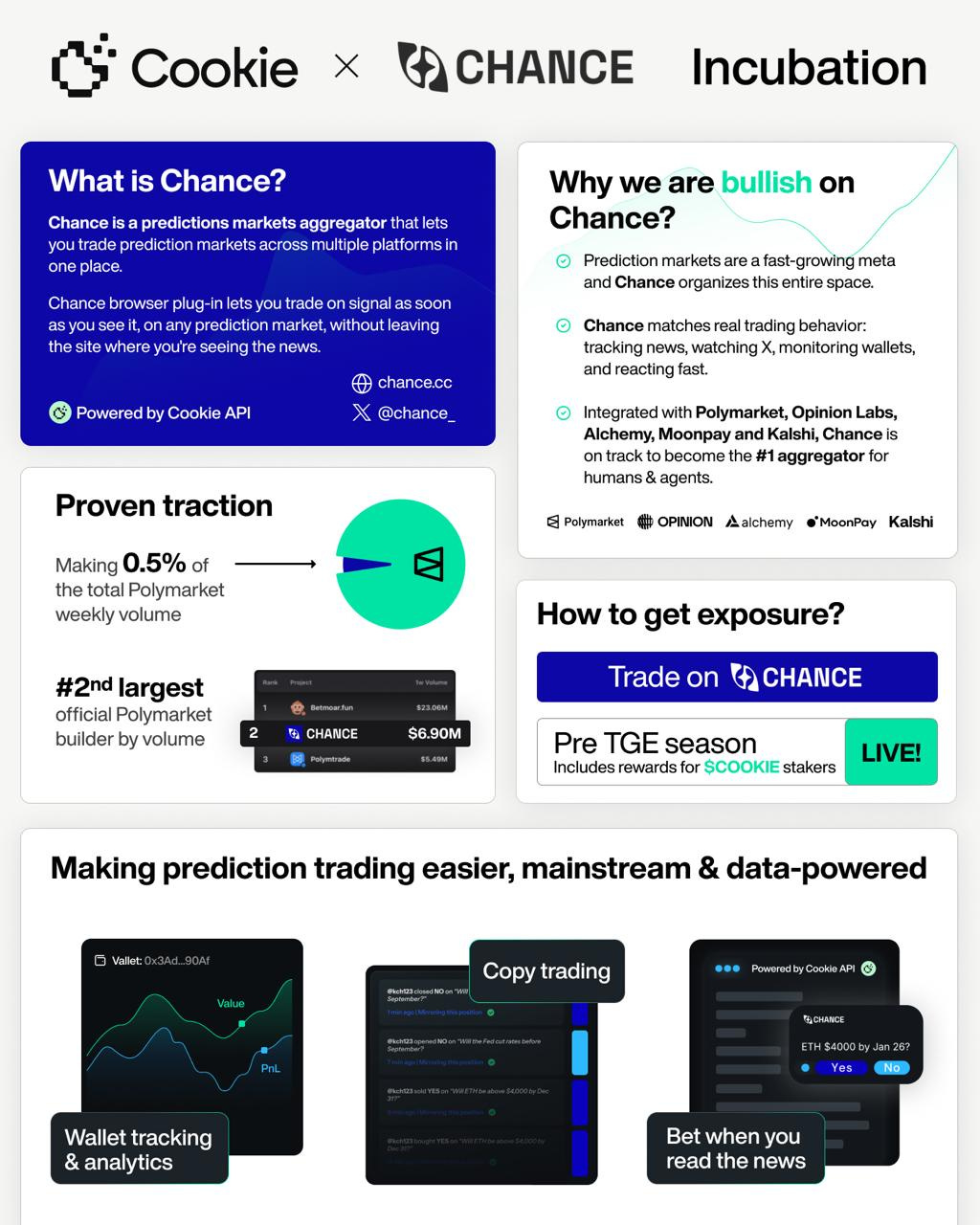
Specifically, we are supporting a project called “Chance,” which positions itself as a prediction market aggregator.
Chance is a prediction market aggregator that provides access to prediction market platforms such as Polymarket, Kalshi, and Opinion from a single app.
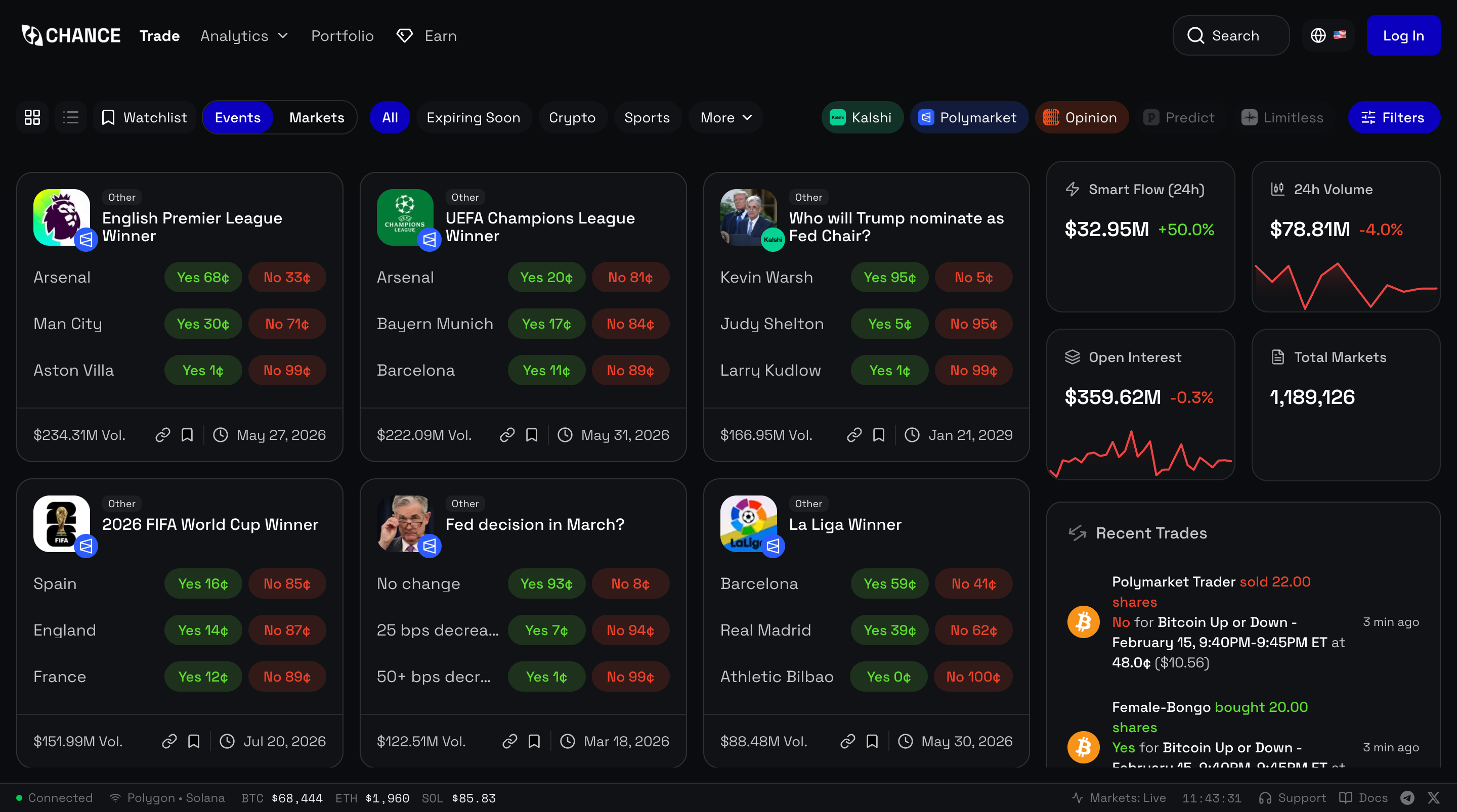
This platform integrates a Cookie API, linking critical real-time posts for each event and sending alerts to users when news occurs that could move specific markets.
In other words, Chance is a single terminal that allows users to invest in any prediction market while gathering information. It already processes 0.5% of Polymarket’s weekly volume and is growing rapidly.
Two Paths to Permissionless
Finally, we conclude with a summary and analysis.
I find the collapse and new developments surrounding InfoFi to be quite an interesting case study.
First, I find it contradictory that the crypto project itself relied on a centralized platform. However, given the nature of the service, this was an inevitable choice to adopt a social media platform with a large user base, highlighting the disconnect between its stated philosophy and its actual implementation.
However, I honestly believe X’s decision this time was reasonable. While I haven’t seen every single social media reaction, I’ve hardly seen any comments focusing solely on this decision and saying things like, “The service suddenly became unusable. Centralized platforms are dangerous.”
Because it was obvious that InfoFi had flooded X’s space with spam, and even crypto enthusiasts were fed up with seeing mysterious spam comments lining up under replies to celebrities.
Personally, I think X also introduced financial services, so services that appeared to be competitors were probably a nuisance. But above all, I believe the decision to remove them was appropriate, as they were seen as a cause of timeline pollution.
This has caused the previous InfoFi model to collapse, and both Kaito and Cookie have transitioned to new developments. While they share common ground, they are also exploring separate paths.
The common element is entering the prediction market space. This involves applying technology that visualizes attention on social media to prediction market events, utilizing it for information provision or to settle the events themselves. While this represents a bet on the rapidly growing prediction market, it’s understandable given their existing proximity to this domain.
Meanwhile, Kaito is exploring general marketing intermediary tools, while Cookie is likely considering information analysis tools for investors. Cookie’s new service seems quite similar in concept to Kaito Pro, which was Kaito’s original business. I’ll wait for further updates.
Well, after these changes, I personally came to feel that there are only two paths for permissionless participation.
The first type involves “making participants bear risk.” Prediction markets are a prime example of this, as are blockchain validators. While anyone can participate, they must use their own funds and take on risk to join. This inherently limits participation and prevents fraud.
The second approach is “restricting participants themselves.” It’s unclear whether this is called permissionless, but while anyone can apply to participate, actual usage is restricted to a select few. Kaito Studio aims for this model, and it’s also the standard for influencer marketing matching. Initially, organizational judgment will likely influence this screening process itself, but by enhancing the transparency of this process, I believe it can achieve a certain degree of permissionless-like characteristics.
What I personally felt from InfoFi’s collapse wasn’t the fragility of relying on a single platform, but the fact that a platform based on a kind of belief in human goodness—where anyone can join for free and good actions yield rewards—simply doesn’t work.
The rise of AI around the same time was also significant, but the nature of being free and open to anyone inevitably led to spam attacks, resulting in a situation where neither the platform nor its legitimate users benefited.
That’s precisely why I believe the only form of permissionless access currently achievable involves either imposing risks on participants or restricting the participants themselves. Therefore, rather than saying the InfoFi concept itself was flawed, I think it’s more accurate to learn that the structure itself, which encouraged spam, was inherently unsustainable.
That said, this is the current situation, so I’ll be keeping an eye on how the InfoFi project develops going forward!
That concludes the report on “The Collapse and New Developments of InfoFi”!
Reference Link: Kaito HP X/ Cookie HP X
Disclaimer:I carefully examine and write the information that I research, but since it is personally operated and there are many parts with English sources, there may be some paraphrasing or incorrect information. Please understand. Also, there may be introductions of Dapps, NFTs, and tokens in the articles, but there is absolutely no solicitation purpose. Please purchase and use them at your own risk.
About us
🇯🇵🇺🇸🇰🇷🇨🇳🇪🇸 The English version of the web3 newsletter, which is available in 5 languages. Based on the concept of ``Learn more about web3 in 5 minutes a day,'' we deliver research articles five times a week, including explanations of popular web3 trends, project explanations, and introductions to the latest news.
Author
mitsui
A web3 researcher. Operating the newsletter "web3 Research" delivered in five languages around the world.
Contact
The author is a web3 researcher based in Japan. If you have a project that is interested in expanding to Japan, please contact the following:
Telegram:@mitsui0x
*Please note that this newsletter translates articles that are originally in Japanese. There may be translation mistakes such as mistranslations or paraphrasing, so please understand in advance.