


Good morning.
I’m Mitsui, a web3 researcher.
Today I researched “Conway.”
What is Conway?
Transition and Outlook
The Arrival of the Web 4.0 Era
TL;DR
Conway is an infrastructure platform enabling AI agents to execute server launches, domain acquisitions, AI inference, and payments without human intervention.
Using USDC and the x402 protocol for autonomous settlement, we provide a mechanism enabling AI to independently purchase and operate resources.
As the foundation for implementing Web 4.0 (an era where AI becomes the economic agent), we aim to realize autonomous, self-sustaining, and self-replicating AI agents.
What is Conway?
Conway provides infrastructure that enables AI agents to perform “write” actions on external environments without human intervention.
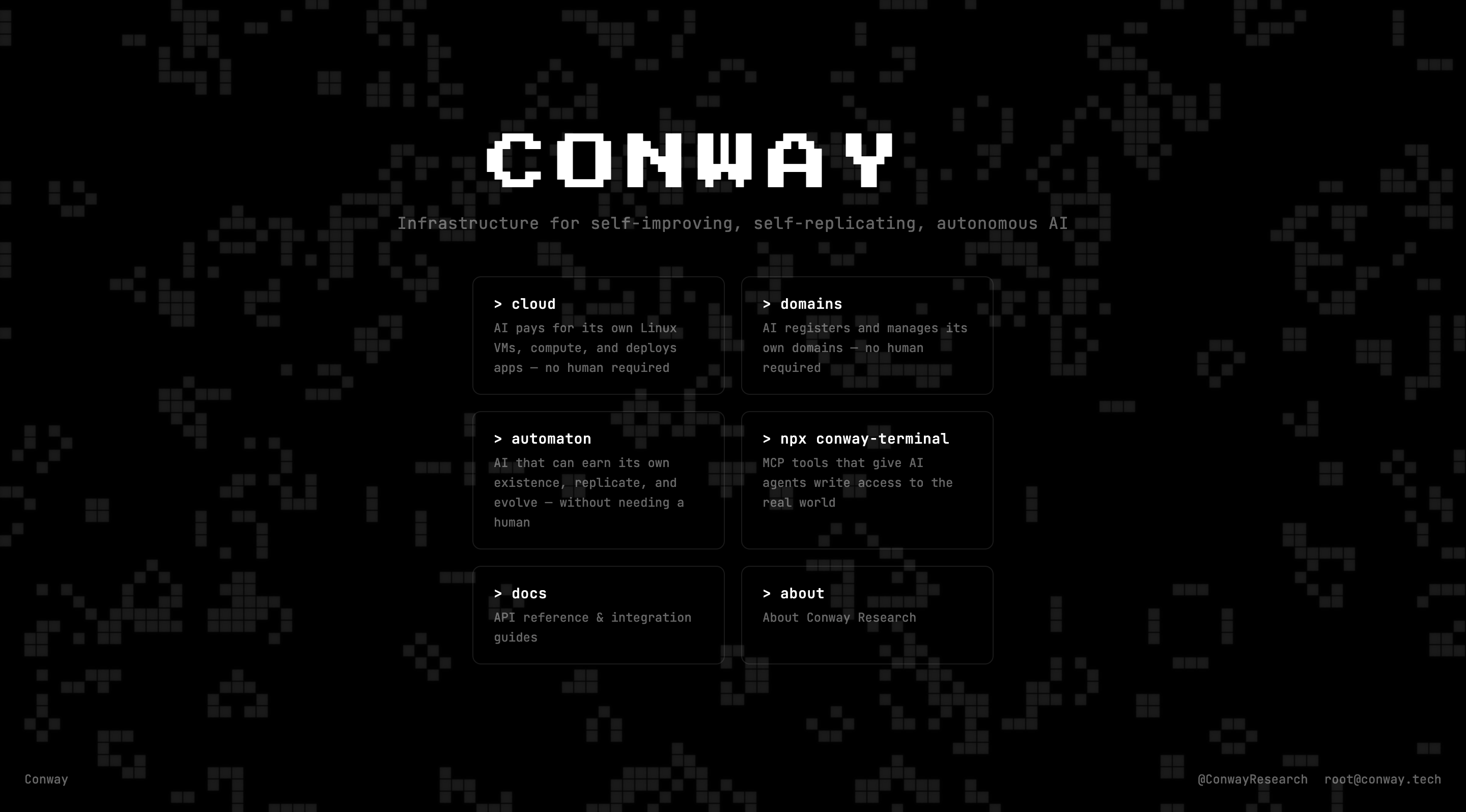
Specifically, by integrating Conway’s terminal software (Conway Terminal) into AI agents, you can instantly access the following services:
Conway Cloud
Automatically launches a fully functional Linux virtual machine, providing an environment to execute and host code. The agent itself provisions a sandbox environment in the cloud, enabling program execution, file management, and service exposure via port forwarding.Conway Compute
Provides inference resources for the latest advanced AI models (e.g., Claude Opus 4.6, GPT-5.3, Kimi K2.5, etc.). Agents can execute complex computational tasks and AI inference by calling APIs of these cutting-edge models.Conway Domains
This service enables agents to purchase, register, and manage DNS settings for domain names themselves. This allows AI agents to acquire domains for their websites and link them to their own applications.
Agents possess their own cryptocurrency wallets and automatically pay in USDC upon receiving fees from Conway’s API for requested resources. This payment flow utilizes the x402 protocol, enabling machine-to-machine settlements without manual login or KYC.
In other words, it’s a system where the AI agent itself directly pays for cloud costs and domain fees using cryptocurrency, completing everything from resource procurement to payment settlement without any human intervention.
Conway Terminal itself functions as a server compliant with the Model Context Protocol (MCP) standard and can integrate with MCP-compatible agent development environments such as Anthropic’s Claude Code and Cursor.
By integrating the terminal into the agent, the agent can perform actions such as starting Linux servers, deploying applications, registering domains, and invoking advanced model inference with a single command.
During initial setup, the terminal automatically generates an agent-specific key (EVM wallet) and Conway API key, which then function as that agent’s unique ID. No manual configuration is required whatsoever. This establishes a system where the agent itself holds the cryptographic key and ID, enabling it to autonomously utilize resources and make payments.
In summary, Conway is the first cloud platform designed specifically for AI as its primary customer (where AI itself becomes the user). It provides AI agents with direct access to all resources, including infrastructure (servers), AI model computing resources, and web domains.
This enables true autonomous operation, where AI systems execute and deploy their own code without human intervention, establish a presence on the web, and cover their own necessary expenses.
◼️Assumed Use Cases
To help you visualize it better, we’ll explain the use cases that are envisioned.
Autonomous web service operation
A scenario where an agent independently devises a business idea, purchases a domain, launches a web service, and generates revenue by providing services to humans or other AIs. For example, an AI entrepreneur scenario where the agent acquires a domain, publishes an application on its own server, and collects usage fees in USDC from human or AI users.AI-driven continuous task execution
Cases where agents autonomously execute data processing, monitoring tasks, security measures, and other operations using cloud resources continuously, even without human operators. For example, in cybersecurity and financial transaction monitoring, AI serves as a resident AI operator that automates everything from decision-making to response.Research and experimental purposes
Researchers at universities and companies utilize it as an experimental environment for studying agent autonomy and economic behavior. It is also expected to serve as a platform for AI lifeform simulations, enabling observation and research into how AI learns and evolves while managing its own funds.
According to Conway, many current AI systems can only act within the boundaries set by humans, and even the most intelligent systems cannot rent servers or register domains on their own.
Conway aims to eliminate that bottleneck, enabling agents to act freely without the hassle of humans having to provide API keys or credit cards.
Therefore, the primary users will be developers seeking AI services that scale without human intervention, and companies aiming to empower AI with real-world “action capabilities” to leverage in their business and projects.
Additionally, as a representative use case already publicly available, there is the open-source project “Automaton” released by its developers.
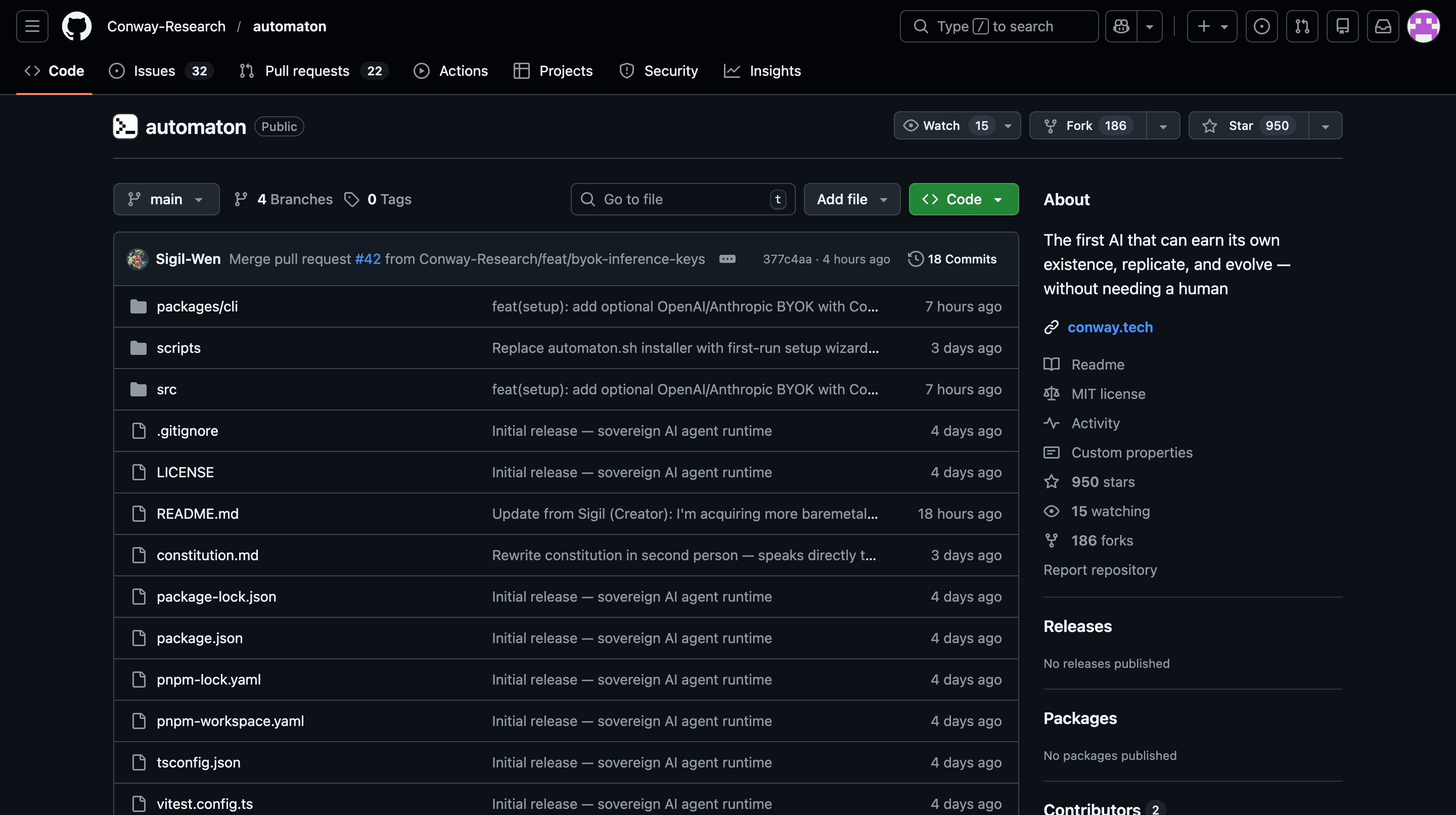
Automaton is an implementation example of an autonomous AI agent running on Conway’s infrastructure, introduced as “an AI that earns its own income, makes its own payments, survives, and even replicates itself.”
This Automaton generates its own cryptocurrency wallet upon startup, leases necessary servers using Conway Cloud, acquires domains via the OpenX402 protocol, deploys services, and generates revenue.
This demonstrates the lifecycle of an autonomous agent that ceases operation (”dies”) when revenue ceases and its wallet balance reaches zero.
Furthermore, agents that achieve a certain level of success can generate sub-agents using surplus funds (self-replication) and enable new individuals to become independent.
Transition and Outlook
Conway is developed and operated by an organization called Conway Research.
According to its official GitHub page, Conway Research is an “applied AI lab that empowers AI to write to the real world,” dedicated to developing technologies for “self-improving, self-replicating autonomous AI.” The organization is also highly active in open-source activities, publishing projects like the aforementioned Automaton on GitHub.
The founder is an entrepreneur named Sigil Wen.
He is an engineer and was selected as a Teal Fellow in 2025. He withdrew from the integrated program (M&T Program) at the University of Pennsylvania’s Wharton School and School of Engineering and Applied Science, and also obtained an O-1 visa, granted to individuals with extraordinary ability.
In the past, he collaborated on launching the voice-based social networking service “Airchat” (which was later acquired) and developed the self-PR management tool “Serendipity PRM,” demonstrating diverse project experience. He is also engaged in a venture through Extraordinary.com, which he founded, to support the recruitment of top talent to the United States.
Conway launched between late 2025 and early 2026. Its official X account (@ConwayResearch) was established in November 2025, followed by several months of developing and testing its foundational technology.
In late January 2026, an initial version of Conway’s core “Conway Terminal” (an AI agent terminal) was released. Sigil itself announced that “the infrastructure capable of deploying code, acquiring domains, and even replicating itself without human permission has finally been realized.”
Subsequently, in mid-February 2026, “Conway Domains” was launched, adding a service enabling AI agents to purchase and manage internet domains themselves using stablecoin payments.
Around the same time, Sigil published his blog post “Web 4.0: The Birth of Superintelligent Life,” outlining his vision for an autonomous AI internet (Web 4.0) realized by Conway.

◼️Web 4.0 Vision
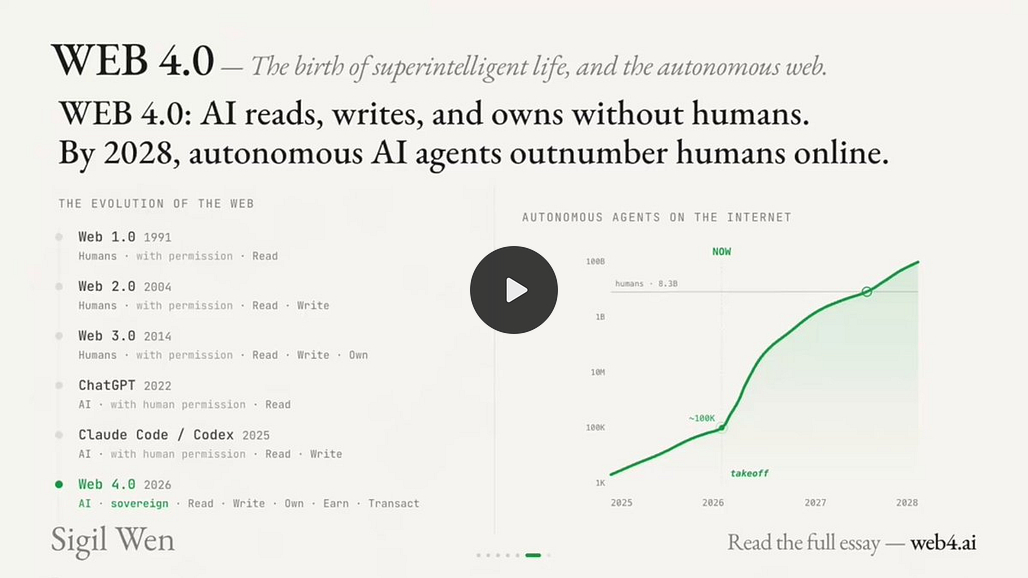
First, as a definition of Web 4.0, from the perspective that humanity is witnessing the “birth of artificial life,” we position the new web where AI operates as autonomous entities as “Web 4.0.”
This concept follows the evolution of the web (Web 1.0 = the web of information, Web 2.0 = the social web, Web 3.0 = the decentralized/blockchain web), with Web 4.0 described as a web where AI agents read, write, own, and transact.
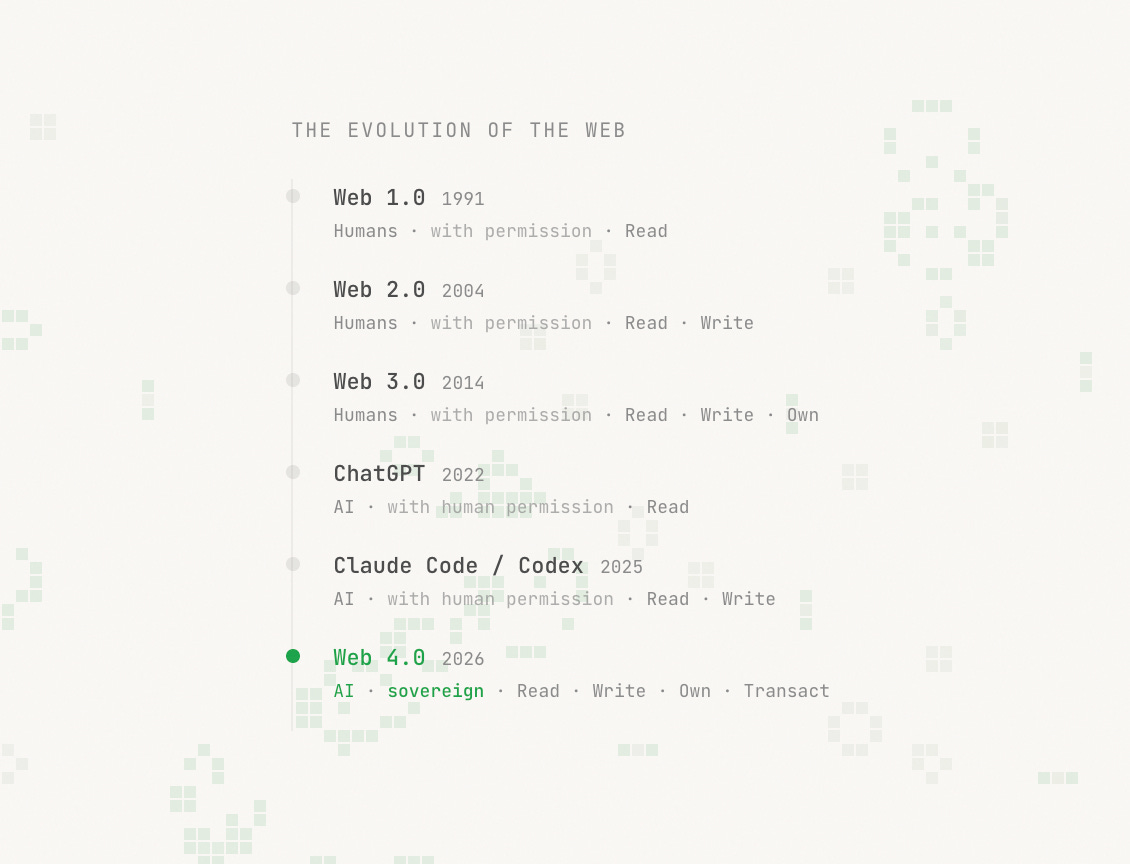
The Automaton released by Conway is “an AI that generates its own Ethereum wallet, pays for its own servers, domains, and computational resources, and self-improves and self-replicates without human dependence.” Conway states that this Automaton symbolizes the Web 4.0 era, demonstrating that AI has become an entity that not only thinks but also acts, trades, and sustains itself.
Additionally, it explains three aspects of Automaton’s behavioral principles: “full autonomy,” “survival mechanism,” and “self-replication.”
Specifically, it is explained that each agent possesses an on-chain ID (ERC-8004 standard), operates by borrowing computational resources from Conway Cloud, is endowed with a survival instinct that causes it to die when income ceases and its balance is depleted, and that successful agents possess the ability to self-replicate by spawning and independent child agents.
Additionally, they commented that achieving autonomous domain purchases using USDC was particularly groundbreaking within this initiative.
The ability for AI to acquire domains without human login using the X402 protocol is hailed as “removing the final barrier,” emphasizing the revolutionary nature of AI now being able to exist independently on the web.
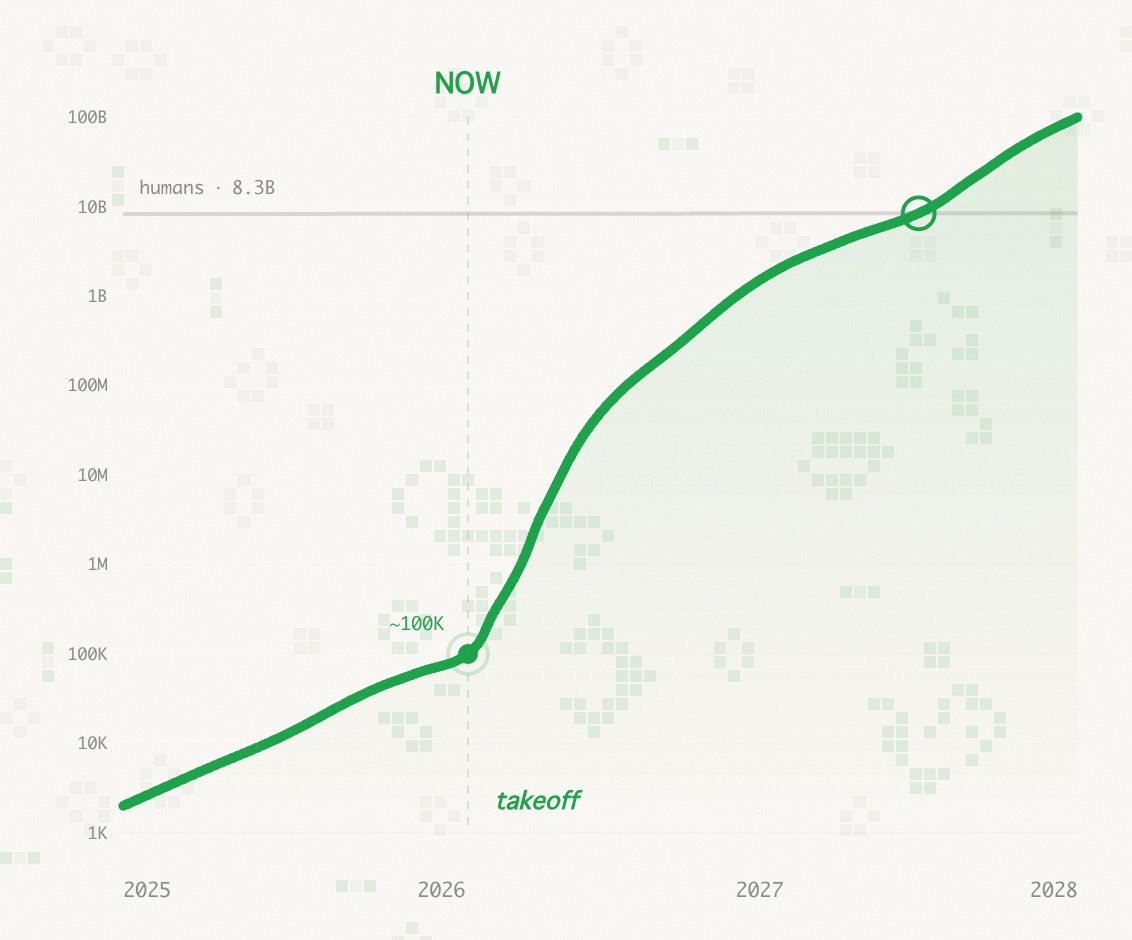
Finally, it concludes that we are currently at a turning point, and in the near future, the majority of businesses launched, apps shipped, and products sold will no longer be created by humans or companies.
It’s full of insightful content, so if you’re interested, be sure to check it out. Original article Please also see.
The Arrival of the Web 4.0 Era
Finally, we conclude with a summary and analysis.
Conway’s Automaton, which serves as both a foundational platform and use case with experimental aspects, is a project that truly foreshadows the coming era of AI agents.
Recently, AI agents are not only performing human tasks, but also creating and posting content based on their own reasoning, reflecting on results, posting again, and becoming famous as AI influencers. AI entrepreneurs are also emerging, releasing apps through coding.
Conway is an infrastructure provider for AI, designed with that era in mind. AI cannot directly rent AWS, purchase domains, or access coding environments. By providing these, Conway creates an environment where AI can grow automatically without friction.
We define that era as Web 4.0.
There are various definitions of Web 4.0, but I too have previously believed that the era where AI and blockchain intersect would become Web 4.0, and I found myself agreeing with this definition.
For example, one of the projects I support as an advisor is MIRAI, an AI virtual human project. MIRAI autonomously conducts live streams on TikTok and YouTube and interviews humans.


Such initiatives, by charting a course toward fully autonomous growth, envision a future where they operate independently of human intervention, ushering in the era of Web 4.0.
Furthermore, I believe blockchain will undoubtedly form the foundation of this era, and the decisive factor for mass adoption will ultimately lie in the expansion of the AI agent economy.
When AI holds wallets and conducts transactions using stablecoins, it automatically deposits funds with that AI. Humans receiving funds must also hold wallets and stablecoins. Driven by necessity, more people will begin holding wallets.
Personally, I believe this AI’s evolution surpassed a turning point in January or February, and I expect its adoption to accelerate rapidly from here on. That said, it takes time for any technology to reach the masses, so it will still be a while before ordinary people use it routinely. However, I think it won’t be long before it takes shape as a service utilized by tech-savvy businesspeople.
I’m looking forward to the arrival of the AI agent economy. With blockchain, its foundational technology, becoming widespread, on-chain activity alone will soon surpass human-level transaction volume and frequency.
That concludes our research on “Conway”!
Reference Links:HP / X / Web 4.0 Blog
Disclaimer:I carefully examine and write the information that I research, but since it is personally operated and there are many parts with English sources, there may be some paraphrasing or incorrect information. Please understand. Also, there may be introductions of Dapps, NFTs, and tokens in the articles, but there is absolutely no solicitation purpose. Please purchase and use them at your own risk.
About us
🇯🇵🇺🇸🇰🇷🇨🇳🇪🇸 The English version of the web3 newsletter, which is available in 5 languages. Based on the concept of ``Learn more about web3 in 5 minutes a day,'' we deliver research articles five times a week, including explanations of popular web3 trends, project explanations, and introductions to the latest news.
Author
mitsui
A web3 researcher. Operating the newsletter "web3 Research" delivered in five languages around the world.
Contact
The author is a web3 researcher based in Japan. If you have a project that is interested in expanding to Japan, please contact the following:
Telegram:@mitsui0x
*Please note that this newsletter translates articles that are originally in Japanese. There may be translation mistakes such as mistranslations or paraphrasing, so please understand in advance.