


Good morning.
I’m Mitsui, a web3 researcher.
Today, I’ll explain “City Protocol.”
What is City Protocol?
Key Components
Transition and Outlook
Will IPCM be realized?
TL;DR
City Protocol is a decentralized protocol that provides IPCM infrastructure on Solana, tokenizing IP to bring it onto on-chain markets, thereby providing liquidity and scalability.
IPCM is the IP version of ICM (Internet Capital Market), a concept aiming to create a capital market where IP rights and value are tokenized, enabling 24/7 trading year-round beyond geographical constraints.
City Protocol provides full-stack support from IP creation to monetization and financialization, encompassing Cooking City (Issuance) → City Quests/ID/Viral City (Diffusion, Trust, Growth) → Totem Toy City (Commercialization) → RWA City (Tokenization), along with verification layers, IP Strategy, and its native token $CP.
City Protocolとは?
City Protocol is a decentralized protocol built on the Solana blockchain, providing the infrastructure for the IPCM (IP Capital Market).
Its mission is to “liberate cultural and narrative IP assets from closed, traditional ecosystems and place them on on-chain capital markets, thereby providing liquidity and scalability.”
Specifically, creators will tokenize their intellectual property from the project’s inception, enabling fans and communities to participate as co-owners. This allows for fundraising and market price discovery starting at the idea stage, accelerating the IP’s growth cycle.
Before delving into the specific services offered by City Protocol, we will explain “IPCM.”
◼️What is IPCM?
“IPCM” stands for “Intellectual Property Capital Market” and refers to a mechanism that utilizes blockchain to transform intellectual property (IP) into tradable assets within capital markets.
This concept follows the terminology of Solana’s ICM (Internet Capital Market) and has been gaining traction as a term through the end of 2025.
ICM is,A world where anyone with an internet connection can participate in capital marketsThis concept aims to redefine capital markets through asset tokenization, 24-hour trading, and the elimination of intermediaries.
IPCM is the IP version of this system, tokenizing all IP-related concepts to enable free trading 24/7, 365 days a year, beyond geographical and racial constraints.
Primary Components
City Protocol is building a full-stack ecosystem that provides end-to-end support from IP issuance to diffusion, growth, and monetization.
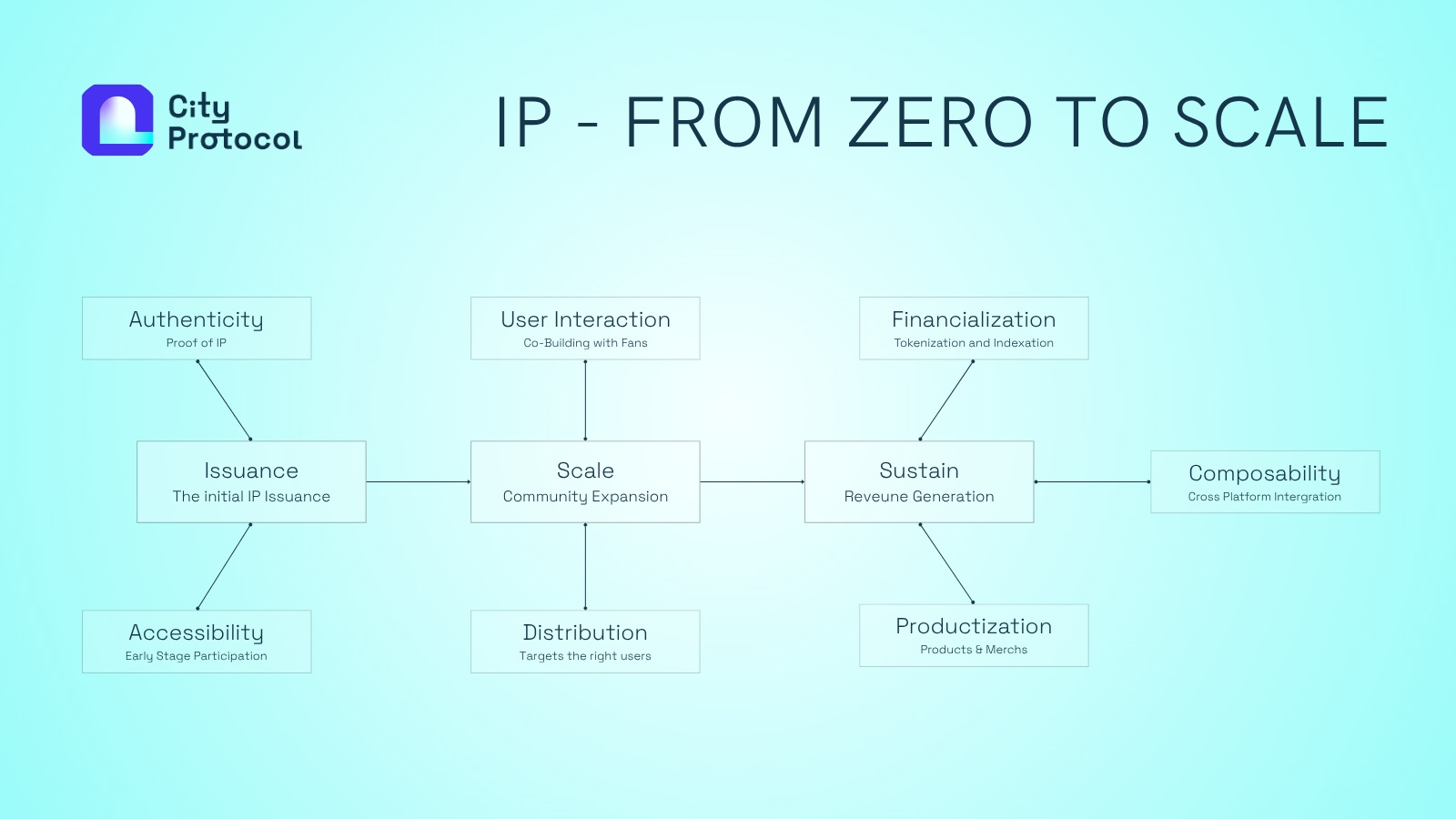
The main components are as follows.
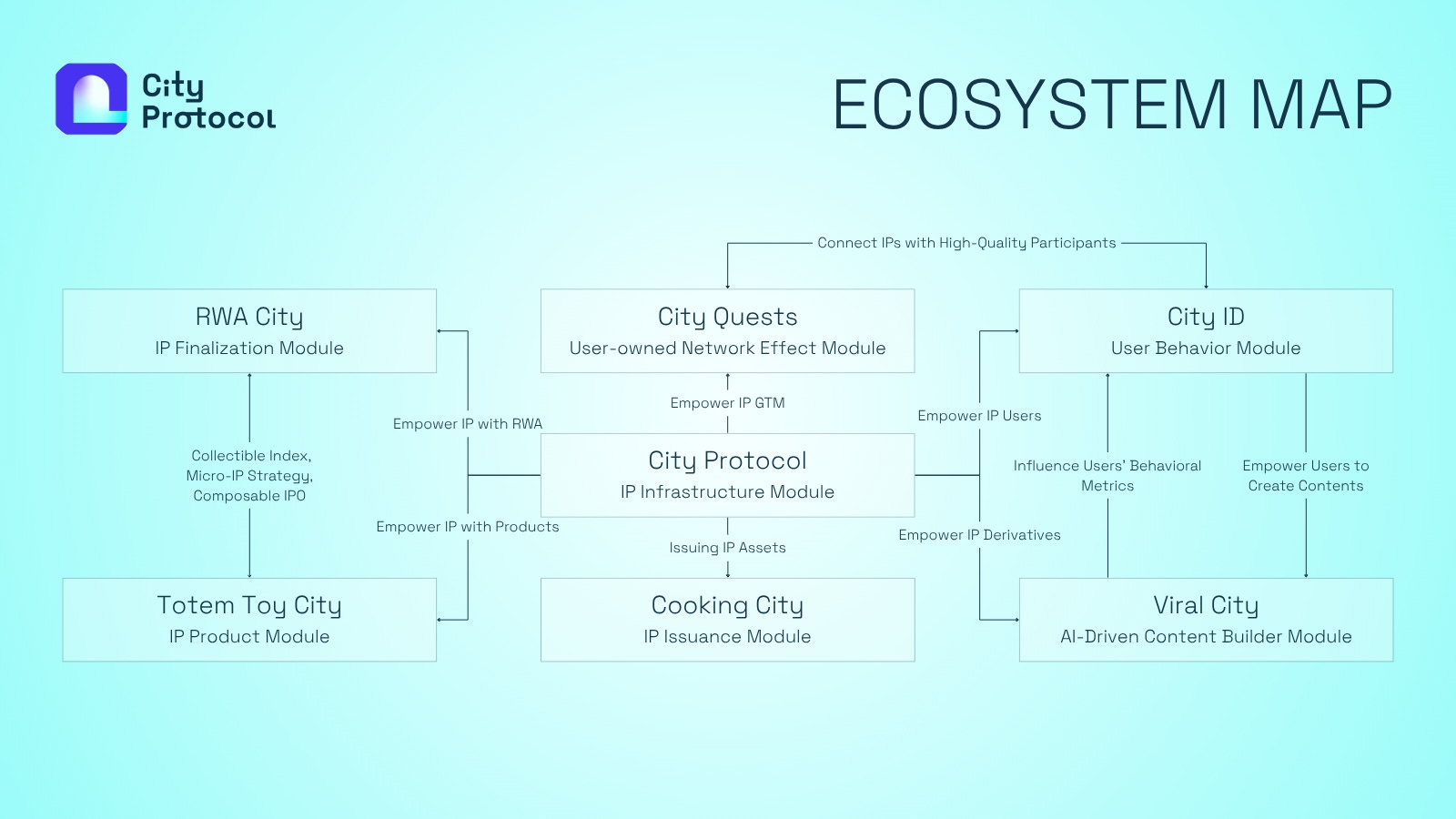
At the center lies “City Protocol,” with each module extending outward in a modular fashion.
◼️Cooking City:IP Issuance Module
A token launchpad platform that tokenizes IP at the idea stage and sells it fairly to early fans and investors.
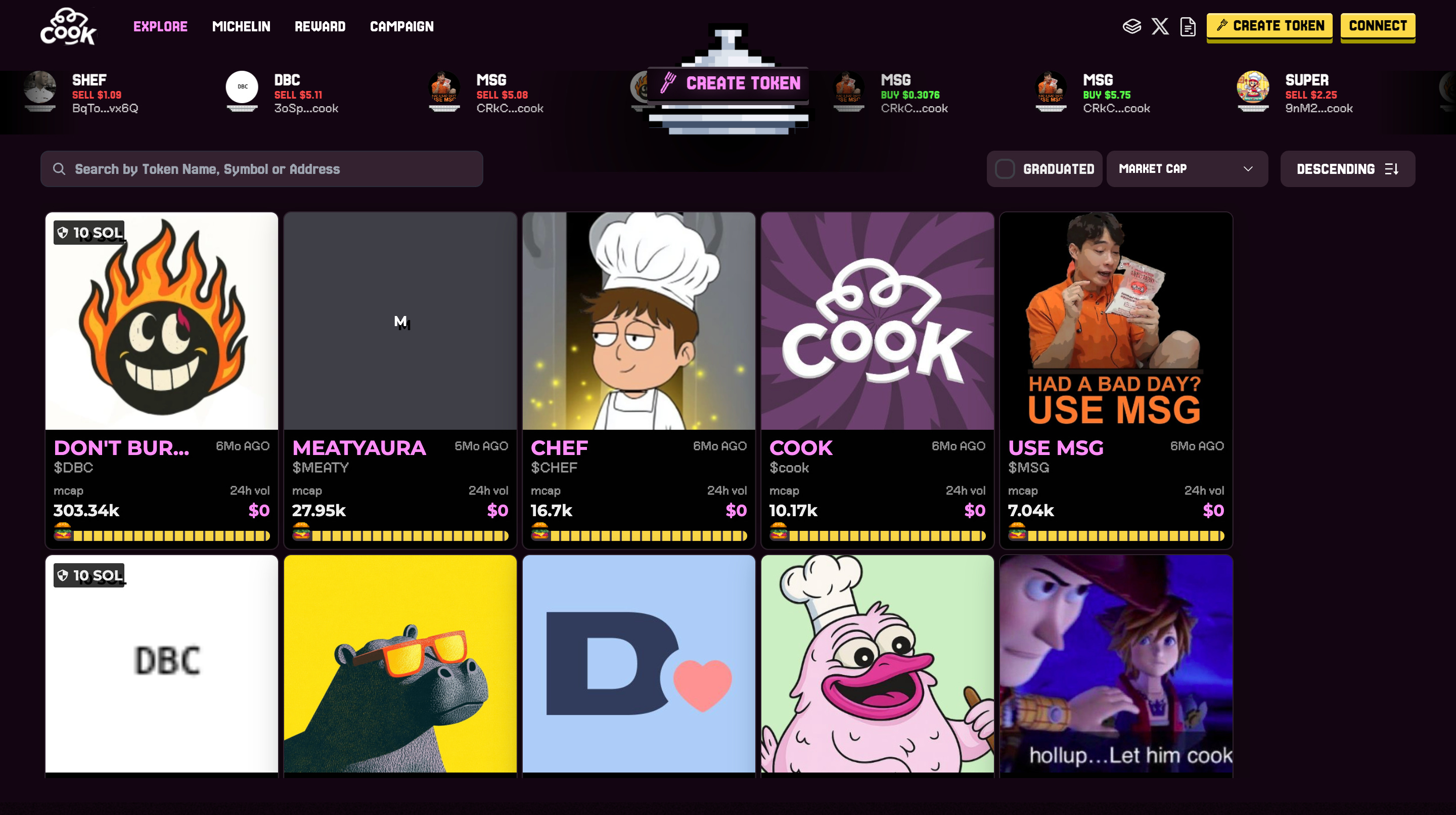
Based on City Protocol’s Issuance Mandate, we guarantee a fair launch free of backdoor deals and pre-allocations. Pricing is left to the market via a dynamic bonding curve, ensuring fair price discovery and liquidity provision from the very start of trading.
Additionally, after issuance, creators receive a portion of transaction fees as revenue, while high-volume traders earn point rewards—a system designed to adjust incentives for all participants.
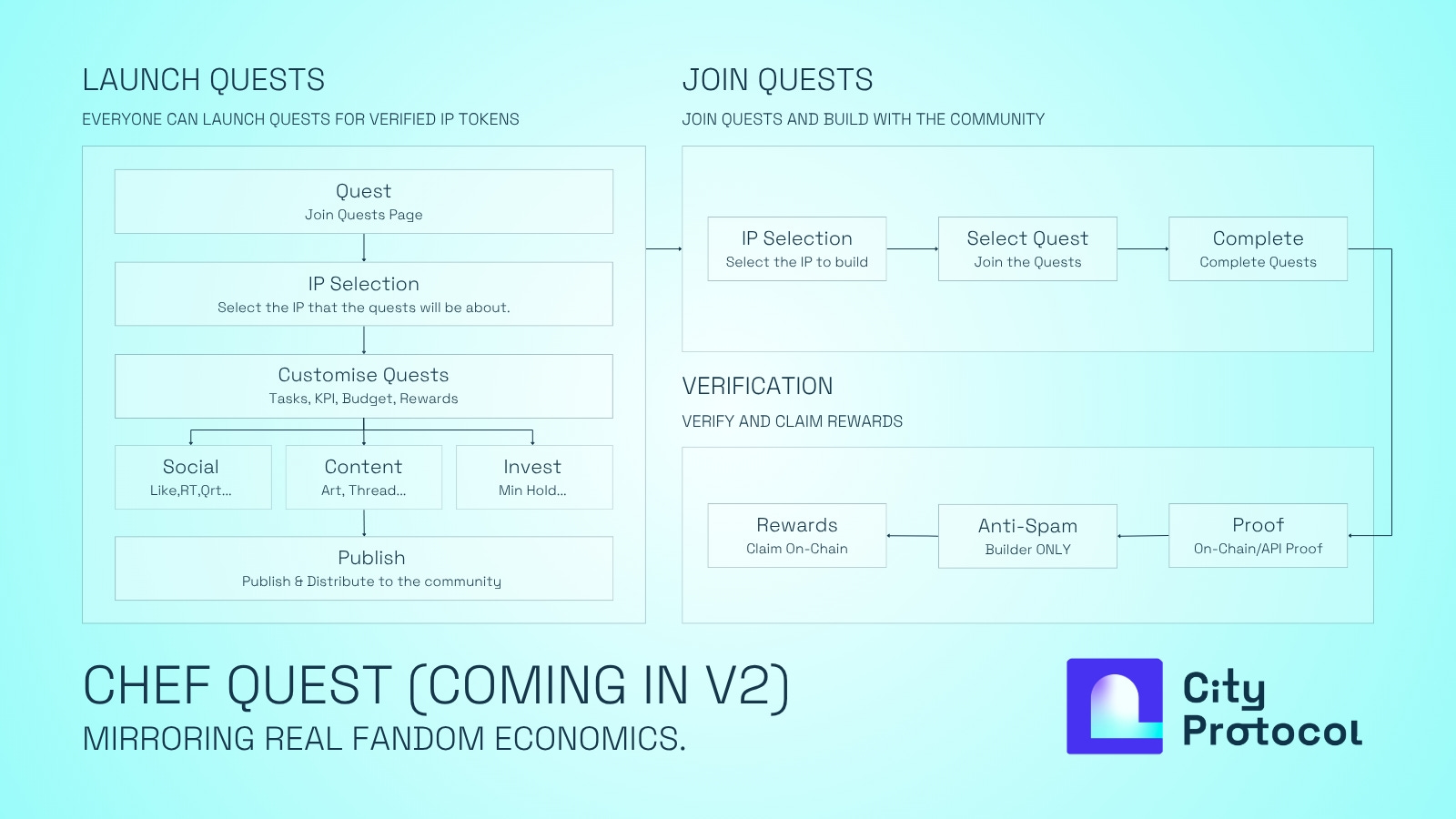
◼️City Quests:User-owned Network Effect Module
We will execute P’s Go-To-Market strategy through community-driven initiatives. By implementing quest-based participation and a reward system based on contributions, we will transform fans from mere “consumers” into Participants and ContributorsThis is a module that changes it.
This is currently under development and is scheduled for release in V2.
◼️City ID:User Behavior Module
It is a mechanism akin to a credit score that identifies individuals who truly add value within highly anonymous Web3 environments.
City ID visualizes and evaluates users’ on-chain activities from three perspectives.
Trading Performance: Trends in IP Token Investment and Holding (Whether to hold during market crashes, soundness of profit-taking, etc.)
Community Contribution: Organizing City Quest events, promoting collaborations, and solving challenges—contributions to the organization
Content Creation: The volume and quality of fan works and information dissemination related to the IP
By combining these scores, the project team can identify true long-term supporters and capable collaborators.
For example, based on their activity history, profiles emerge such as “holders who support without ever selling,” “fans skilled at spreading content,” and “market makers adept at trading.”
This score is privacy-conscious, designed to prove only that you are a “long-term holder” and have “significant influence” without revealing your balance or real name.
◼️Viral City:AI-Driven Content Builder Module
Viral City is an AI-driven content amplification engine. It is an AI platform that empowers fan communities to mass-produce secondary creative videos and social media content for IPs, enabling them to generate viral buzz.
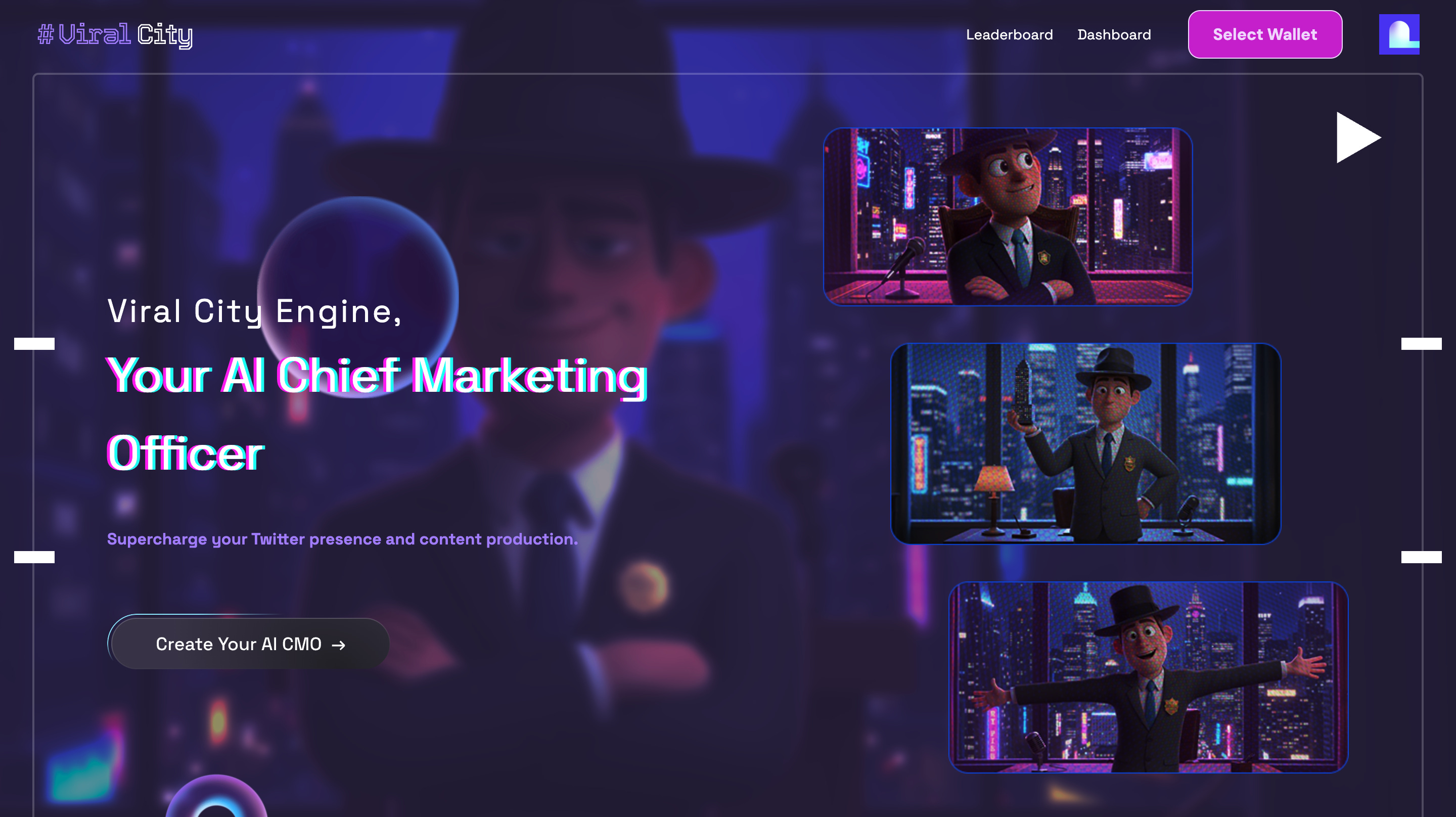
The key feature is that it’s not just a generic AI video generator, but a “dedicated AI trained for each IP.” It learns each IP’s character designs, worldview, speech patterns, and story development patterns through machine learning, ensuring fan-created content maintains official-level quality and consistency.
For example, for short videos on TikTok, AI suggests and generates content that spreads easily on each platform—such as engaging visuals and trending music—while for Instagram, it creates visually striking Reels videos.
Fans can use materials from their favorite IPs to create high-quality videos and images with the click of a button.
Furthermore, all content embeds metadata with the source IP and creator information, enabling transparent tracking of contributions. If a fan video goes viral and attracts new token buyers, the creator’s contribution is recorded and can lead to rewards like quest bonuses.
The most recent V2 update has been released as a base application.


◼️Totem Toy City:IP Product Module
This is a module for physical expansion. For digitally born IPs to truly grow into major brands, physical merchandise expansion and real-world touchpoints are essential.
Totem Toy City is an integrated platform designed to facilitate the seamless creation of physical products (toys, apparel, merchandise, etc.) based on intellectual property.
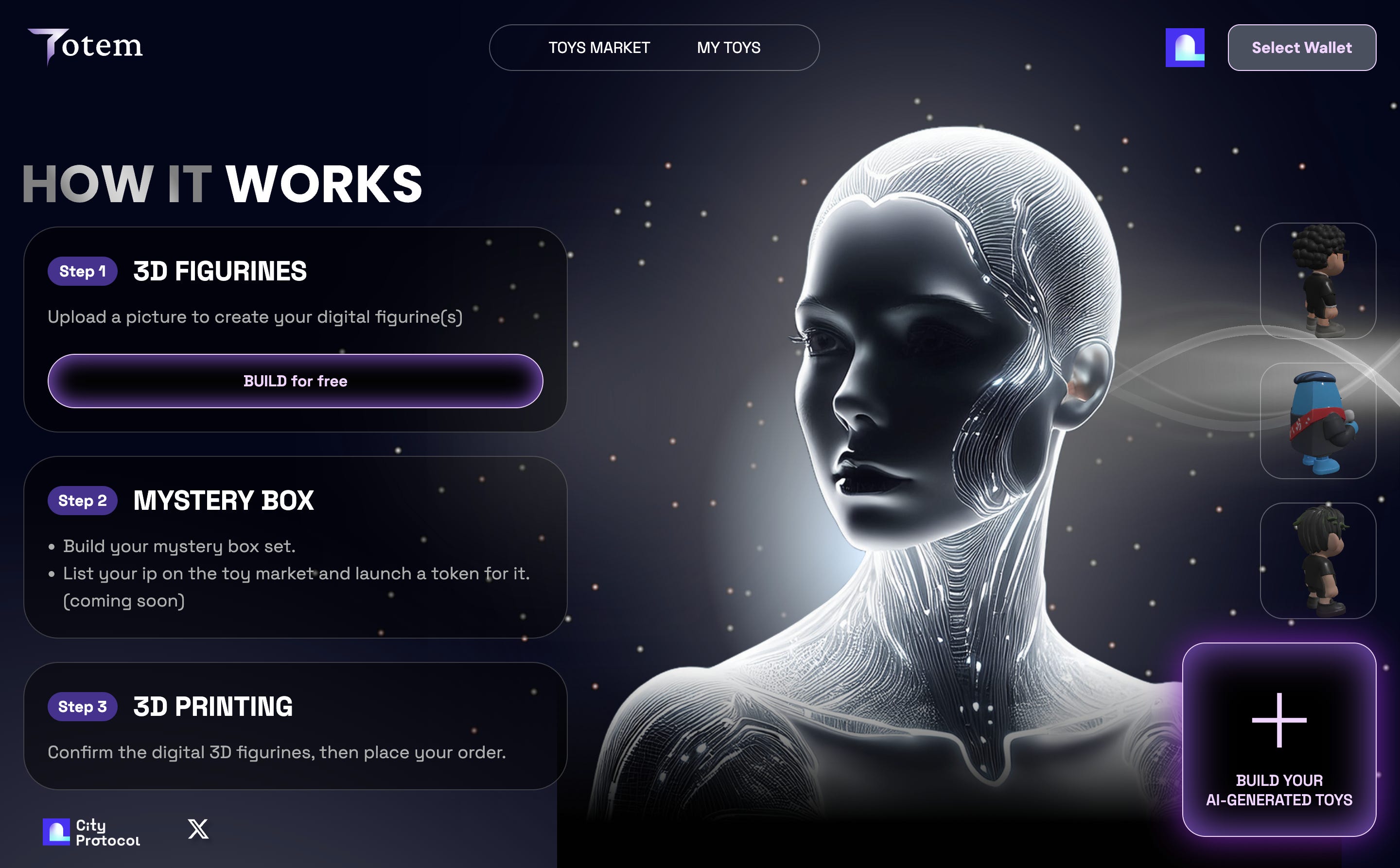
Creators simply upload their character data and designs, and the AI automatically generates 3D printable models and manufacturing specifications, enabling them to place orders with partner suppliers.
From small-batch prototypes to mass production runs of hundreds or thousands, you can select reliable manufacturers based on demand. Inventory management, order processing, and international shipping can all be managed centrally.
Designs that bridge physical goods and digital elements are also possible. For example, you can link physical and digital by attaching NFTs or token benefits to limited-edition merchandise, allowing purchasers to gain advantages within digital communities as well.
◼️RWA City:IP Finalization Module
This is the final module that completes IP as an RWA, elevating IP to an “investable and manageable asset class.”
RWA City serves to finalize IPs issued within the City Protocol ecosystem’s Cooking City and grown through City Quests / Viral City / Totem Toy City, establishing them as financially viable entities.
While not yet a concrete product, we will establish a framework to treat IP as RWA connected to on-chain financial infrastructure. This includes tokenizing each IP individually, of course, as well as developing index products that handle multiple IP tokens.
◼️IP Verification Layer
This is a trust assurance module, a mechanism that guarantees the authenticity and reliability of issued IP tokens.
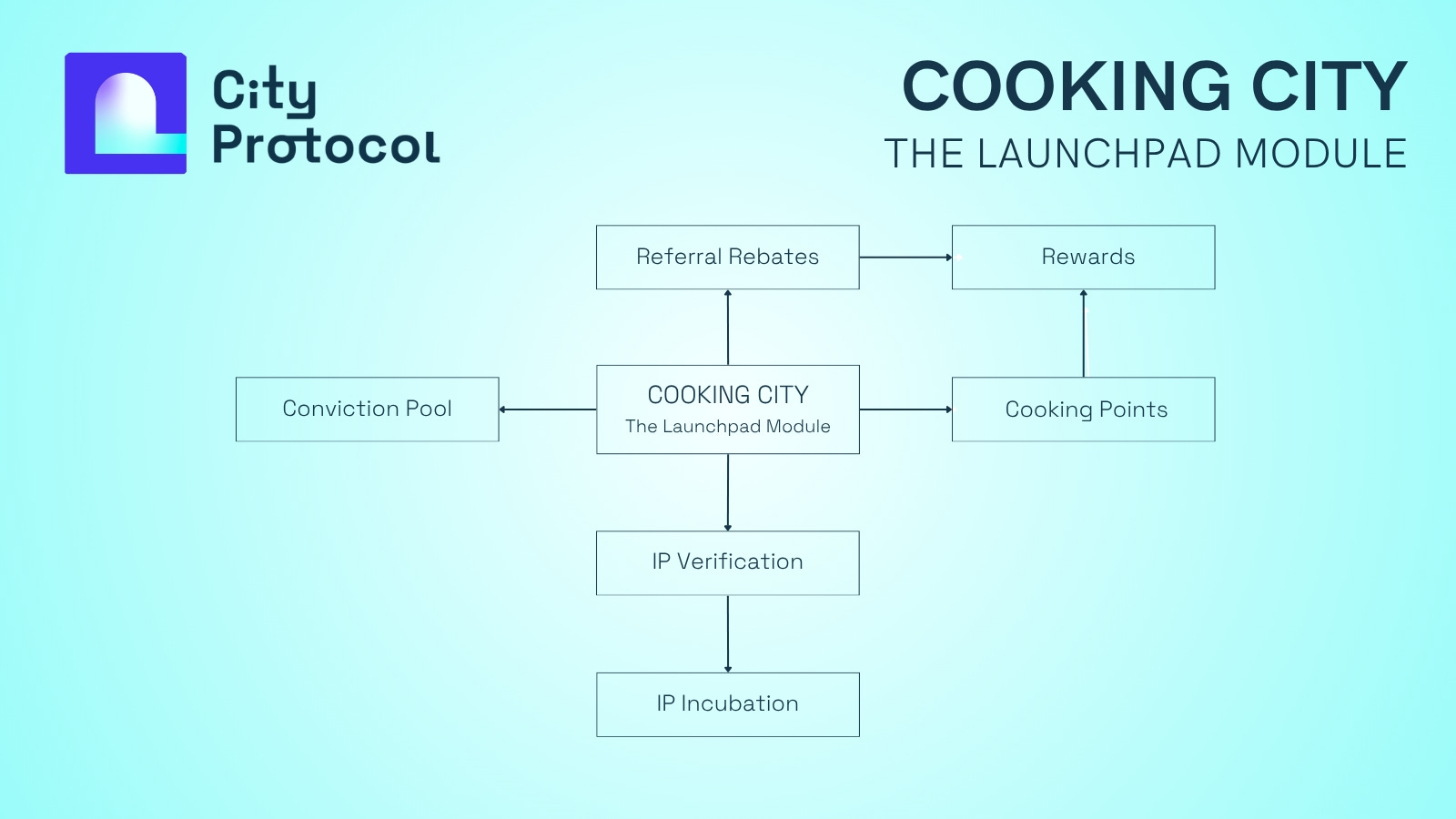
Permissionless verification allows creators to link their social accounts to tokens, enabling them to prove on-chain that “this token represents my intellectual property.”
Projects that have achieved a certain level of performance undergo permissioned verification (additional confirmation by the operator), where ownership of IP rights and development commitment are verified.
Verified projects receive advisory support, grants, and promotional assistance from City Protocol, along with access to advanced analytics dashboards and AI tools (such as Viral City).
◼️IP Strategy
This mechanism follows the NFT Strategy model, using token transaction fees to support the floor price of already issued NFTs.
As a specific use case, in October 2025, Mocaverse, Animoca’s flagship NFT collection, and City Protocol jointly launched a token called “$MOCASTR”.
80% of the 2.5% trading fee from $MOCASTR tokens is automatically accumulated into the treasury. These funds will be used to implement automated trading strategies aimed at maintaining the floor price of Mocaverse NFTs.
Using accumulated treasury funds, we purchase NFTs at floor price and relist them at 1.2 times that price. When this sale succeeds, we use the profits to buy back and burn $MOCASTR tokens, thereby increasing both token value and treasury funds.
In fact, $MOCASTR has demonstrated promising results, such as purchasing approximately 40 Mocaverse NFTs within 48 hours of its public launch on the Solana mainnet, pushing the floor price up by 15% and achieving a yield equivalent to 20% on an annualized basis.
◼️Token Information
To reiterate, City Protocol is the project that comprehensively supports IP tokenization using the aforementioned modules.
And as the native token to circulate this ecosystem, “$CP” exists.
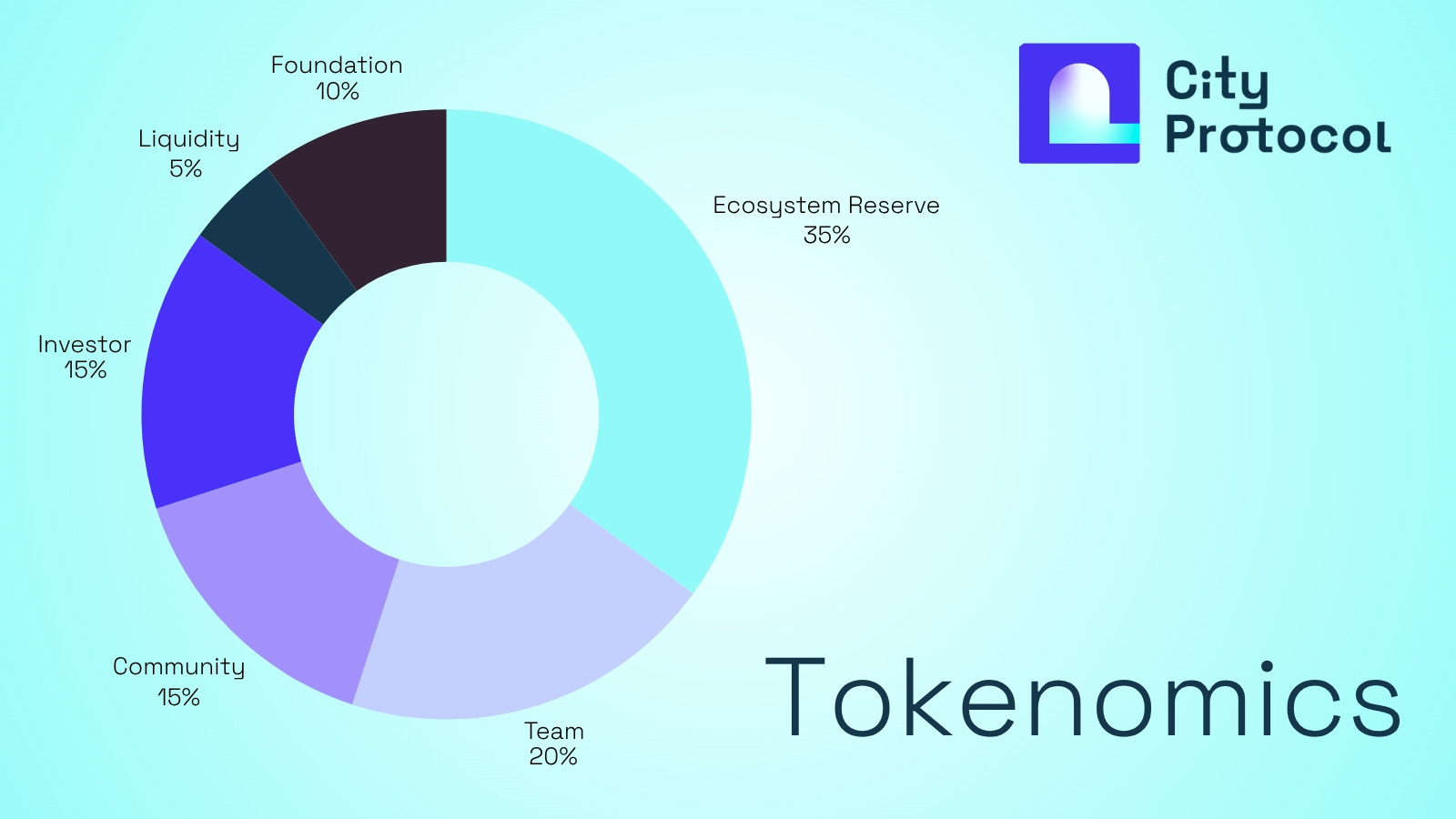
The primary utilities include governance participation, settlement currency, incentive rewards, and staking with associated benefits. Additionally, a portion of the platform’s revenue will be periodically allocated to $CP buybacks, with repurchased $CP being deposited into the project treasury.
The allocation is as follows. The TGE has not yet occurred.
Transition and Outlook
The City Protocol’s basic platform concept was unveiled in October 2025.
The co-founders are Jerome Wong and Kyle, and the team includes individuals from prominent web3 projects such as Animoca Brands, The Sandbox, Dapper Labs, and Memeland, as well as those with experience at major corporations including HSBC, MediaAsia, and LVMH.
Traditionally, creating massive IPs like Disney, Marvel, or Nintendo required substantial capital and publisher backing, often leaving the brilliant ideas of small and medium-sized creators buried.
City Protocol was born to change this situation. It transforms IP into verifiable, tokenized investment assets from the initial stages, providing a mechanism for creators to receive support directly from global fans and investors without intermediaries. This enables an open and equitable IP ecosystem independent of middlemen and opaque royalty systems, aiming to ensure cultural value is appropriately returned to creators and their communities.
Additionally, the company completed a seed funding round in May 2025, raising approximately $7 million.
This round includes Jump Crypto, Dragonfly, CMT Digital, Mirana Ventures, Bitscale Capital, Everest Ventures Group (EVG), and others.
◼️Future Roadmap
We will organize the future roadmap as inferred from official documentation and announcements.
①IP Marketplace
Currently, we are primarily focused on issuing IP tokens and initial trading, but we plan to build a comprehensive secondary marketplace in the future.
Specifically, we aim to create a platform where users can search for and trade IP-related products using filters such as IP, year, rarity, condition, and transaction speed.
It is expected to become a secure C2C marketplace supporting diverse listing formats such as fixed-price sales, auctions, and Dutch auctions, while also featuring escrow (third-party deposit) and dispute resolution functions.
Each transaction generates a transparent receipt using a City ID (a record of who purchased which IP’s product), which is utilized for IP holder rewards and user performance management.
②Micro IP Strategy Fund
The introduction of index-based IP strategy funds that allow for diversified investment across multiple IPs is also under consideration. For example, the concept involves establishing a rule-based buyback and market-making pool that manages tokens from multiple IPs under a defined theme, such as the “2024 Anime IP Basket.”
③Gacha Machine
We are also planning an on-chain gacha feature that pairs well with entertainment IP. Users can spin the gacha using $CP or IP tokens to randomly win IP-related items, NFTs, or limited-edition merchandise vouchers.
VRF (Verifiable Random Function) ensures the fairness of winning outcomes, and the drop table (prize types and probabilities) is publicly disclosed to guarantee transparency. We plan to implement limited-time gacha events as seasonal activities or collaborations with other projects, developing them as community-participation entertainment elements.
④ Expanding Tools for Creators
Creator support tools for developing and deploying IP on the platform will also be enhanced. The Launchpad feature will enable advanced issuance settings, such as supply schedules (vesting or phased unlocking) during token issuance and whitelists (sales slots accessible only to specific City ID holders).
Additionally, an automated revenue routing feature is planned, enabling the distribution of transaction fees and sales proceeds to creators, stakers, collaborators, and other contributors according to pre-set percentages.
These tools enable creators to meticulously design and manage their IP ecosystems while operating through an intuitive UI that doesn’t require technical expertise.
Will IPCM be realized?
Finally, we conclude with a summary and analysis.
Tokenizing intellectual property is a fascinating concept that has garnered significant attention, but no successful examples have emerged yet. While rights surrounding various forms of IP—such as copyrights, licenses, and music tracks—have been tokenized in the past, the envisioned ideal has not been realized.
Even if tokenization enables temporary fundraising, significant challenges remain: it risks separating fans from investors, and revenue distribution and token price appreciation depend heavily on achieving success as intellectual property—an extremely difficult domain.
However, personally, I believe this field holds tremendous potential. And I also think that rather than tokenizing existing well-known IPs, building IP from scratch using crypto-native tokenization is the faster path to success.
Of course, successfully launching an IP from scratch is difficult, so tokenizing well-known IPs is also important in the short term. However, well-known IPs have complex rights issues, making tokenization extremely challenging. Furthermore, existing fans already exist, so striking a balance with them is also necessary.
However, if it’s a new IP, that’s a different story.
That said, if the IP cannot be made famous, the token’s value will completely disappear, so caution is necessary here. Furthermore, profit sharing can raise questions about whether the token qualifies as a security, while tokens without profit sharing often become meme coins and may not necessarily align with the IP’s success.
Furthermore, the legal issues are complex. Even if revenue sharing is possible, payments and contracts would likely be handled off-chain, with the distribution occurring on-chain. This coordination must also be addressed.
Despite these numerous challenges, I personally believe the IPCM market still holds significant potential. I believe blockchain will tokenize everything and bring financial elements into every industry, and the IP and entertainment sectors are no exception.
However, since it’s necessary to consider and verify what kind of design approach to take, I plan to conduct my own research and experimentation.
That concludes our research on “City Protocol”!
Reference Links:HP / DOC / X
Disclaimer:I carefully examine and write the information that I research, but since it is personally operated and there are many parts with English sources, there may be some paraphrasing or incorrect information. Please understand. Also, there may be introductions of Dapps, NFTs, and tokens in the articles, but there is absolutely no solicitation purpose. Please purchase and use them at your own risk.
About us
🇯🇵🇺🇸🇰🇷🇨🇳🇪🇸 The English version of the web3 newsletter, which is available in 5 languages. Based on the concept of ``Learn more about web3 in 5 minutes a day,'' we deliver research articles five times a week, including explanations of popular web3 trends, project explanations, and introductions to the latest news.
Author
mitsui
A web3 researcher. Operating the newsletter "web3 Research" delivered in five languages around the world.
Contact
The author is a web3 researcher based in Japan. If you have a project that is interested in expanding to Japan, please contact the following:
Telegram:@mitsui0x
*Please note that this newsletter translates articles that are originally in Japanese. There may be translation mistakes such as mistranslations or paraphrasing, so please understand in advance.