


Good morning.
I’m Mitsui, a web3 researcher.
Today is “Aztec NetworkI researched about [the subject].
What is Aztec Network?
Technical Details ①: Transaction Flow
Technical Details ②: State Management
Use case
Token Information
Will it become the leading contender for zk rollups?
TL;DR
Aztec Network is a privacy-first Layer 2 zk-rollup that ensures transaction validity using zkSNARKs while keeping transaction details confidential. It is designed with client-side execution on PXE as its starting point.
User transactions are processed through the following flow: PXE → Sequencer → AVM → Kernel/Rollup/Squisher circuit → Ethereum finality. This bridges the Public State (account model) and Private State (Note/Nullifier) using ZK proofs.
Projects targeting diverse “privacy × use case” combinations such as DeFi, NFTs, ID, voting, and OTC exist.
What is Aztec Network?
Aztec is a privacy-first Layer 2 zk-rollup.
By utilizing cryptographic proofs via zkSNARKs, it is designed to prove transaction validity while concealing details, allowing users to flexibly choose which information to disclose publicly and which to keep private. Specifically, it encrypts and hides elements such as the amount transferred, the counterparty, and the internal state of smart contracts, while ensuring network-wide consistency through zkSNARKs.
This approach aims to achieve both anonymity and advanced smart contract functionality, unlike privacy-focused cryptocurrencies such as Monero and Zcash, which have had their features restricted for privacy protection.
Before delving into the technical details, let me first explain the evolution.
◼️Evolution
The Aztec Project was founded in 2018. Its first attempt, Aztec 1, demonstrated private payments (encrypted transactions). While the implementation at the time was very slow and gas costs were high, it was a pioneering example of enabling confidential payments on Ethereum.
Following its release in 2021, Aztec Connect expanded privacy capabilities beyond simple transfers into the DeFi space. By providing users with private assets like zkDAI and zkETH, which could be deposited into platforms like Aave and Uniswap via bridges, Aztec Connect delivered an experience that “completely anonymized Ethereum transactions.”
While achieving success with over 100 DApps connected and more than 100,000 users, it faced limitations such as the inability to deploy general smart contracts and dependence on a centralized Sequencer. Consequently, new usage was discontinued in 2023.
At this juncture, the Aztec team shifted its focus to the “next-generation encrypted rollup” concept, accelerating the development of its foundational technology from late 2023 through 2024. In 2023, the specifications for the new rollup were published, and in 2024, implementation of the internal devnet progressed in preparation for the testnet.
Following the Devnet launch in August 2025 and the Provernet deployment in September, the official roadmap was announced in October, bringing us to the present. As of late 2025, verification of a decentralized network called “Ignition,” involving operators worldwide, is underway.
Permissionless Sequencer nodes and Prover nodes are already operational on the testnet, and we have confirmed that block generation and proof creation can be performed stably.
Following this Ignition phase, the next stage is “Mainnet Alpha.” The initial mainnet version, scheduled for the first half of 2026, is expected to implement economic security through token staking while gradually unlocking features as needed.
◼️Fundraising
Since its founding in 2018, the company has secured investments from prominent VCs such as Paradigm and a16z, as well as Ethereum co-founder Vitalik Buterin, raising over $170 million in total funding.
This abundant funding has enabled us to accelerate development by bringing together top researchers and engineers in zero-knowledge proofs. Technologically, we have also collaborated with the Ethereum Foundation and other projects, establishing ourselves as a hub within the ZK ecosystem.
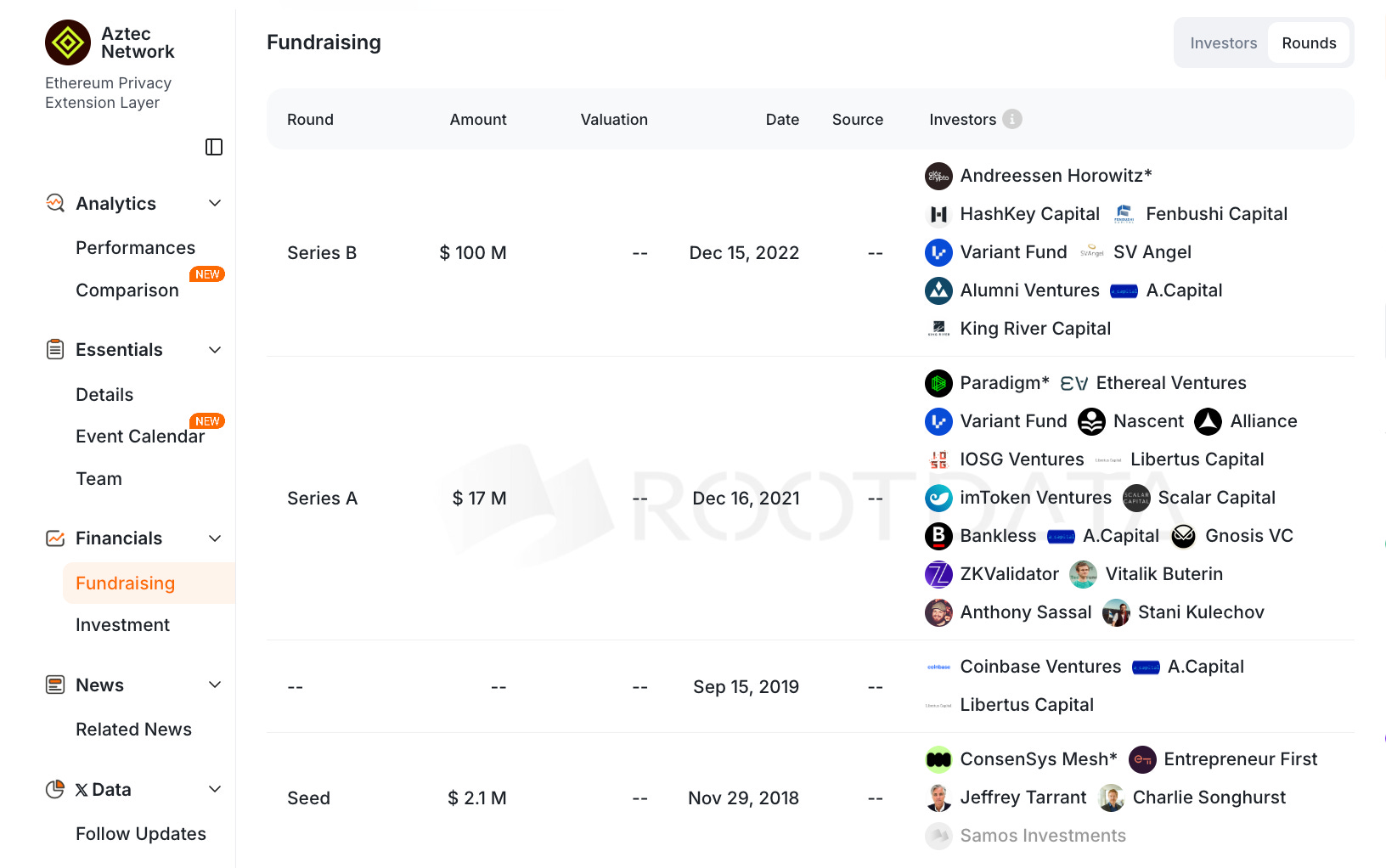
As will be discussed later, we conducted token sales in November and December 2025 to raise additional funds.
Technical Details ①: Transaction Flow
Now, let’s move on to the technical explanation. However, there are many highly specialized terms, and much of the content requires prior knowledge. I’ll do my best to explain it clearly, but if you want a deeper understanding, please refer to the documentation. Also, feel free to ask questions via comments or DMs, and I’ll provide further explanation.
◼️Basic Structure
First, I’ll explain the overall picture.
To put it simply, the user’s transaction first executes in a private environment (referred to as PXE), and its zk-proof is transmitted to the public network. Here, Aztec’s nodes verify and roll up the transaction before committing it to Ethereum, the Layer 1 network.
Aztec is also called a zk zk Rollup because it compresses user transactions using zero-knowledge proofs and then further verifies and compresses those proofs.
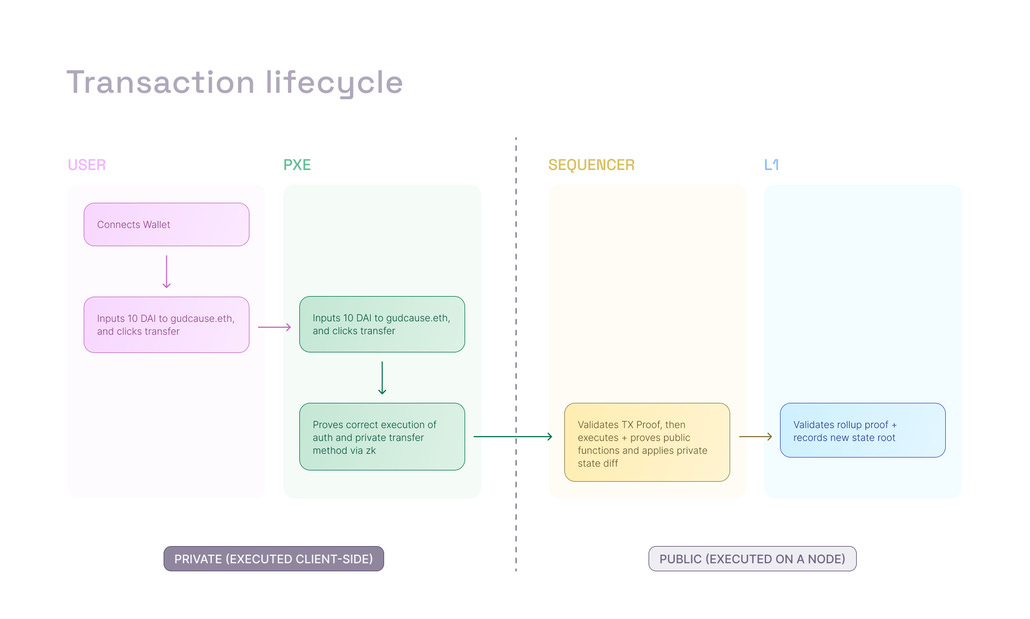
Now, let me explain in a bit more detail. Starting from the left of the diagram above, I’ll explain along the sequence of the transaction flow.
◼️PXE(Private Execution Environment)
First, what makes Aztec unique is its architecture, which executes part of the transaction on the client side.
