


Good morning.
I’m Mitsui, a web3 researcher.
Today I researched “Alpaca.”
What is Alpaca?
Transition and Outlook
API services as financial infrastructure
TL;DR
Alpaca is a fintech company designed for embedded finance, serving as an API-first brokerage infrastructure that provides trading, accounts, clearing, and data via APIs.
It handles stocks, ETFs, options, and cryptocurrencies at low cost, serving a wide range of users from individual algorithmic traders to fintech companies and financial institutions.
Stripe’s financial infrastructure, akin to a securities version, enables embedded services to focus on UX and customer acquisition while monetizing through markups on fees.
What is Alpaca?
Alpaca is a fintech company founded in 2015 in Silicon Valley, USA.
We will explain each service and usage scenario one by one.
◼️Services Offered
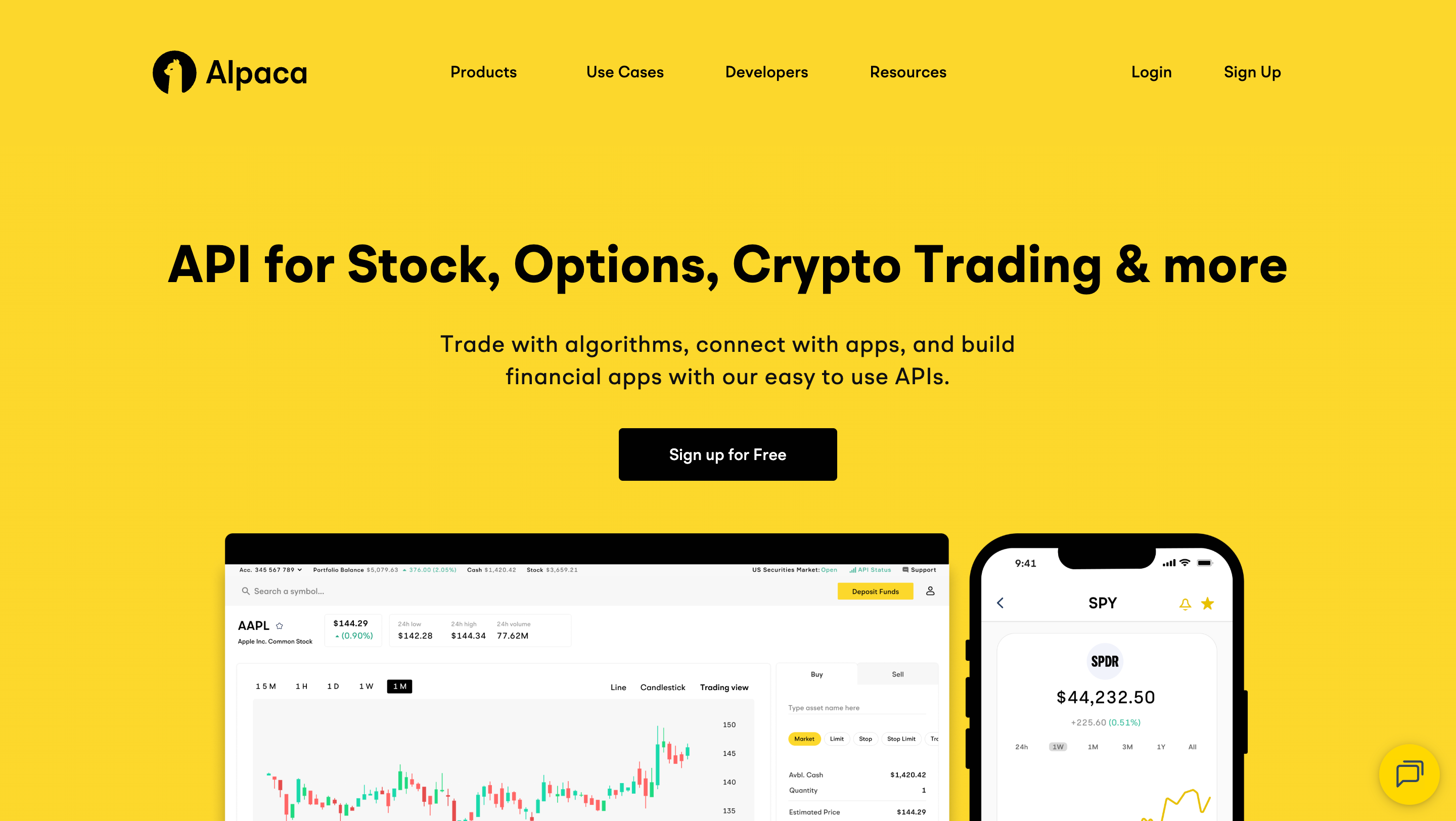
Alpaca currently provides API-first broker infrastructure, primarily offering the following services:
Trading API:This is a trading API for individual and algorithmic traders. Through REST-formatted endpoints and WebSocket/SSE, it enables order placement for stocks, ETFs, and cryptocurrencies, portfolio management, and account information retrieval.
Broker API:Fintech companies and other firms within their own servicesIntegrate securities trading functionalityA comprehensive API for all purposes. From end-user securities account opening (KYC), deposit and withdrawal processing, order execution, to portfolio display,Provide end-to-end brokerage servicesIn other words, it’s a service akin to a “brokerage version of AWS.” By leveraging Alpaca’s infrastructure, other companies can outsource their backend regulatory compliance and clearing, allowing them to focus solely on frontend development.
Market Data API:U.S. stocks, cryptocurrencies, options, etc.Market Data Distribution ServiceWe provide historical data spanning over seven years, real-time stock prices and order book information, and news feeds via REST and WebSocket.
Connect API (OAuth integration):This API enables third-party applications and services to connect to and authenticate users’ Alpaca trading accounts (OAuth2). For example, it allows integration where users log in to their Alpaca account from external platforms like TradingView and execute trades within that application.
Other Services:In addition to the above, we also provide the FIX API (for high-speed trading connections for financial institutions) at the protocol level. Furthermore, Alpaca Securities offersWeb-based dashboardMobile apps are also available, allowing even users unfamiliar with API usage to check their account status and perform basic transactions.
◼️Assets Handled
The financial products currently offered by Alpaca are as follows:
U.S. Stocks (Physical Shares):Supports stocks and ETFs listed on major U.S. exchanges (NYSE, NASDAQ, Cboe, etc.). Primarily focuses on securities belonging to the National Market System (NMS), enabling trading of over 8,000 securities.
U.S.-listed ETFs:Similar to the stocks mentioned above, you can invest in major ETFs listed on NYSE Arca and other exchanges. This includes representative ETFs like VOO and QQQ, as well as thematic ETFs and leveraged ETFs.Direct trading from your securities accountYes, I can.
Stock Options:Starting in 2023U.S. Stock Options TradingThe service has commenced. We are a clearing member of the U.S. Options Clearing Corporation (OCC), supporting not only simple call and put options but also complex positions such as spread strategies.
Cryptocurrency:Through Alpaca Crypto,Trading of major cryptocurrencies (Bitcoin, Ethereum, etc.) in physical formThe Crypto API launched in October 2021 and has since expanded its supported assets. Order types are similar to stocks, allowing unified management of both stock and crypto trading through a single API. Cryptocurrency custody is handled by Alpaca Crypto LLC, a FinCEN-registered Money Services Business (MSB) operating in compliance with U.S. regulations.
Other Assets:As assets scheduled for future handling,Futures, FX (foreign exchange margin trading), bonds (fixed-income assets such as government bonds), private equity, international stocksThe roadmap includes initiatives such as fixed-rate securities and 24-hour stock trading (continuous trading on weekdays). In fact, we are progressively expanding our lineup, including the launch of fixed-rate securities and 24-hour stock trading (continuous trading on weekdays) by 2025.
◼️Eligible Users
Alpaca’s services are broadly divided into those for individual investors and those for corporations and developers.
Algorithm-oriented individual traders:For individual investors seeking to automate their trading through programming, Alpaca is the ideal platform. It provides direct market access via its Trading API and is widely used by those who wish to operate using system trading rather than discretionary trading—namely, aspiring individual algorithmic traders and quants.
Fintech companies and startups:Alpaca’s Broker API isB2B2C modelAnd it’s being adopted behind the scenes by numerous fintech companies. For example, digital banks and payment apps offer users features like “investing in U.S. stocks.”If you want to add it, you can use Alpaca’s infrastructure instead of building a securities system from scratch.
Existing financial institutions and securities brokers:Alpaca can also form white-label partnerships with other securities firms and banks, as it possesses its own U.S. clearing and custody capabilities.
Other user segments:In addition to the above, prop trading firms, hedge funds, university financial engineering researchers, and others,All segments seeking direct market access via APIAlpaca is opening its doors. Its mission is to “provide access to markets for everyone on Earth,” and it is incorporating users from emerging economies as well as small investment clubs, not just those in developed nations.
◼️Fee Structure and Charges
Alpaca prioritizes fee transparency, with basic trading fees being free. However, detailed fee structures exist depending on the service and asset class, as outlined below.
Stock and ETF Trading Commissions
Commission (transaction fee) is $0For self-directed individual accounts with Alpaca Securities, there are absolutely no brokerage fees for buying and selling U.S.-listed stocks and ETFs.
This is a commission-free model similar to Robinhood, where Alpaca instead generates revenue through order flow sales (PFOF) at order execution and stock lending fees.
Please note that a small regulatory fee, as required by SEC and FINRA regulations, will be charged for each trade. For example, fees such as the Trading Activity Fee (TAF) of approximately $0.00013 per share (capped at $6.49) and the SEC processing fee of approximately 0.0008% (about $0.80 per $10,000) will be incurred upon sale.
These fees are collected by Alpaca and remitted directly to regulatory authorities, and are passed on to users at cost. There are also no account opening or maintenance fees, nor any minimum balance requirements.
Options Trading Commission
Options trading is also commission-free. However, fees specific to options, such as clearinghouse and exchange fees, will apply.
Specifically, these include FINRA’s TAF ($0.00279 per contract, sell-only), each exchange’s ORF ($0.02685 per contract), and OCC clearing fees ($0.02 per contract, or a flat $55 fee for trades exceeding 2,750 contracts).
For example, trading one contract incurs a total cost of just a few cents, but no brokerage commission is charged. This fee structure is extremely low-cost compared to other firms (typically $0.65 per contract, etc.).
Cryptocurrency Trading Fees
A small transaction fee (spread) is charged.will be done.
Specifically, the fee rate differs between liquidity providers (makers) and liquidity users (takers), and decreases incrementally based on the 30-day trading volume.
For the lowest trading volume tier (under $100,000 in the last 30 days), maker fees start at 0.15% and taker fees at 0.25%. As trading volume increases, these fees gradually decrease, ultimately reaching 0% for makers and 0.10% for takers.
API Usage Fees and Data Costs
The use of Alpaca’s API by individual developers itselfThere is no charge.(An API key will be issued free of charge upon account creation).
For larger API call volumes or high-speed data requirements, subscribing to the paid “Algo Trader Plus” plan ($99/month) provides enhancements such as unlimited REST API calls, real-time data for all markets, and unlimited simultaneous WebSocket connections per security.
Interest Rates and Related Services
When using margin trading (leveraged trading involving borrowed funds), interest accrues on the borrowed amount.
Additionally, the cash balance of uninvested funds is protected by the FDIC up to $250,000 through sweep deposits into FDIC-insured banks and earns interest.
In 2023, the High-Yield Cash Program was introduced, offering competitive interest rates on cash deposits. A portion of this interest income also serves as a revenue source for Alpaca.
Overall, Alpaca emphasizes its “zero commission” policy while providing a platform with a transparent fee structure. There are no account maintenance fees or opaque spread markups common with other companies, creating an environment where users can leverage the trading API at low cost.
Transition and Outlook
Alpaca’s founders are Yoshi Yokokawa (CEO) and Hitoshi Harada (CPO), both entrepreneurs from Japan.

At its founding, the company was data technology-focused, providing large-scale market data processing and machine learning solutions for financial institutions, and developing “MarketStore,” an open-source database specialized for financial time-series data. In 2018, it launched a stock trading API platform, and in 2019, it was accepted into Y Combinator (W19 batch).
The company is expanding its business at a high growth rate and raised approximately $50 million in a Series B round in 2021. Subsequently, in October 2023, it accepted a strategic investment from SBI Holdings (a $15 million convertible bond), bringing its cumulative funding to over $120 million. In 2024, it conducted a Series C round led by China’s Tencent, raising $50 million.
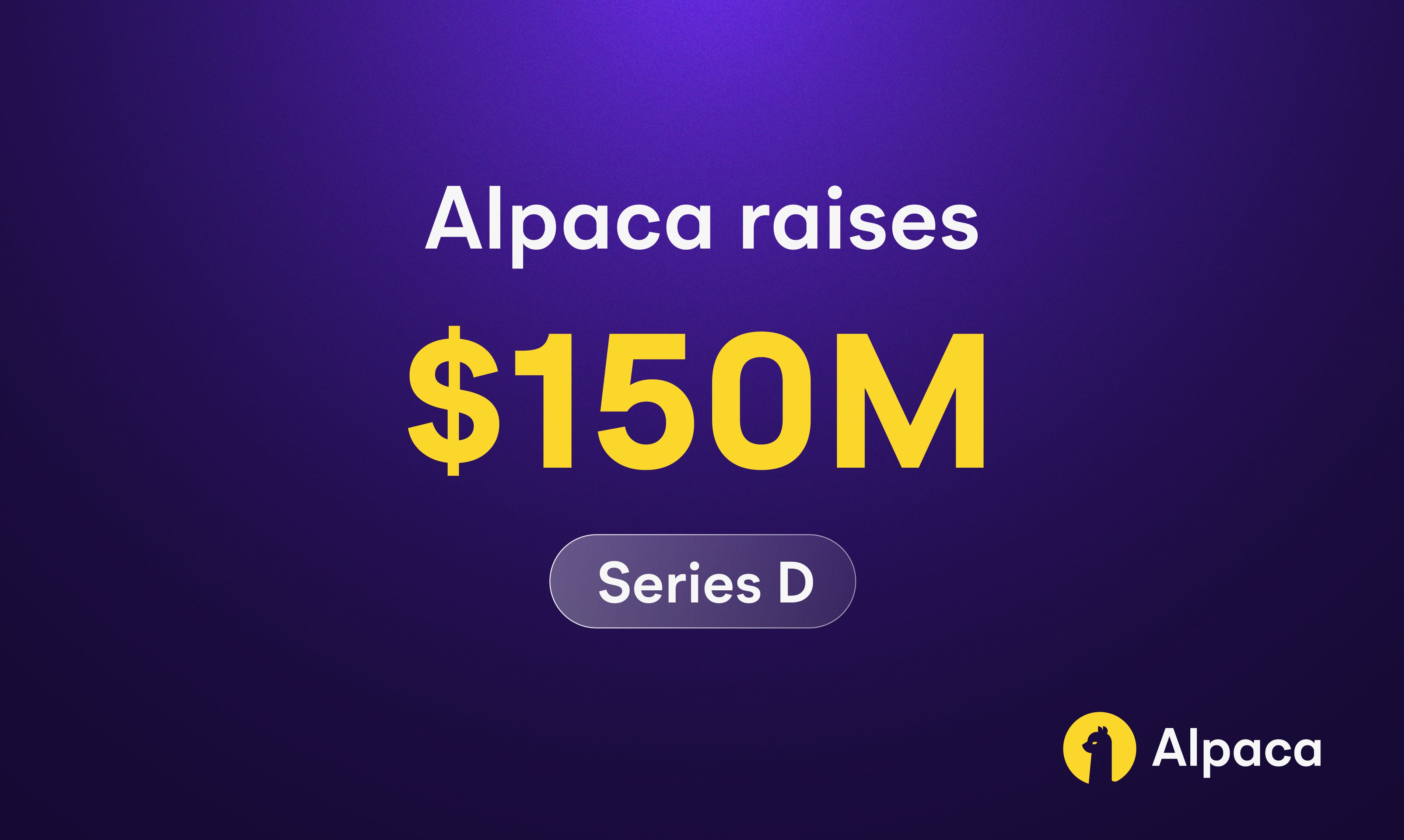
Additionally, it was reported that in January 2026, the company raised $150 million in a Series D funding round, achieving a valuation of $1.15 billion and becoming a unicorn company.
The following are the major changes.
2015:Founded. Applying machine learning and high-speed database technology to the financial sector.
2018:API-based securities brokerage service launches beta version.
2019:Participated in Y Combinator. Raised $6 million in Series A funding (from investors including Spark Capital).
2020-21:Series B funding round completed (total capital raised: $100 million). For individual investors.Commission-free stock API tradingFull-scale service launch begins.
October 2021:Cryptocurrency Trading API Released.
2022–23:Acquired a Japanese small-to-medium securities firm and obtained a broker license from the Japanese Financial Services Agency. Strengthened regulatory compliance framework through measures including establishing the cryptocurrency services company Alpaca Crypto LLC (FinCEN-registered).
2023:Successively introduced options trading functionality, instant deposits, local currency trading APIs, and more. Partnered with and received capital participation from the SBI Group in October.
2024:Series C funding secured. Established self-clearing system and achieved over 200 partner companies and 5 million user accounts.
2025:Expanded services to include fixed-income assets and multi-leg options, along with the launch of 24/5 stock trading. Raised $150 million in Series D funding.
◼️Actual Implementation Cases
Amid rapid growth, Alpaca’s infrastructure is being adopted by various companies and projects worldwide.
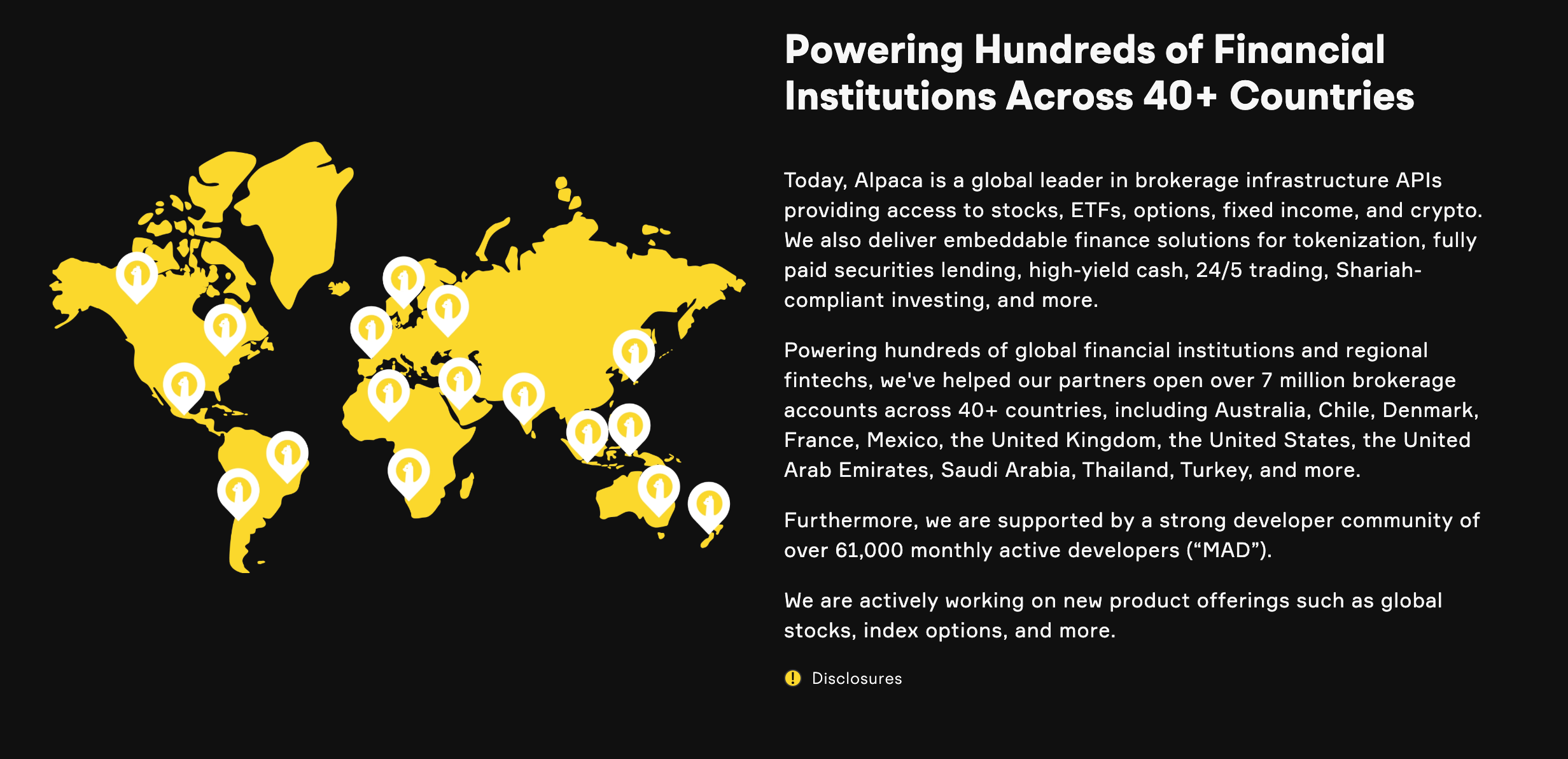
Kraken:Major cryptocurrency exchange Kraken has formed a strategic partnership with Alpaca to launch trading services for U.S. stocks and ETFs for its users. The service is called “Kraken Stocks” or “xStocks” on Kraken, allowing users to buy and sell thousands of U.S. stocks directly from Kraken’s UI. Alpaca’s Broker API powers the service behind the scenes, enabling Kraken users to seamlessly manage both cryptocurrencies and stocks within a single wallet.
SBI Securities・Woodstock:In Japan, the SBI Group has invested in and partnered with Alpaca, while startup Woodstock operates services leveraging Alpaca’s infrastructure. After Alpaca acquired a Japanese securities firm (OI Securities) in 2022 and obtained a license from the Financial Services Agency, Woodstock enabled yen-denominated U.S. stock trading through Alpaca. Woodstock users can invest in over 500 stocks, including Tesla and Apple, starting from just 1,000 yen, with Alpaca handling all order processing and asset custody behind the scenes.
Syfe:Syfe is a Singapore-based asset management fintech offering ETF portfolios and regular investment plans. By integrating with Alpaca, Syfe enables users toInvesting in individual U.S. stocksWe have also opened it.
Dime:Thailand’s digital banking app Dime also utilizes Alpaca. While Dime primarily offered deposit and money transfer services, its integration with Alpaca enables users to accessTrading U.S. Stocks and ETFscan now do.
Sarwa:Sarwa, based in the United Arab Emirates, is a robo-advisor investment service that has been expanding its offerings since 2021 by adopting Alpaca’s API. Sarwa serves investors in the Middle East.U.S. Stocks, ETFs, Cryptocurrencies, Bonds, OptionsAlpaca provides access to diverse assets, backed by its infrastructure.
INDmoney・Vested:Due to regulatory restrictions in India, it is difficult to open accounts directly with overseas securities firms. Therefore, local startups are providing U.S. stock investment platforms. A representative example isINDmoneyやVestedThese platforms utilize infrastructure such as DriveWealth and Alpaca to provide U.S. stock trading services to residents in India.
Greenlight:Greenlight, a U.S. financial education app for children and teens, migrated its stock trading functionality from DriveWealth to Alpaca in 2023. When Greenlight users (parents and children) purchase stocks, their orders are executed via Alpaca.
In addition to the above, Alpaca is also used for prototyping on hedge fund-related platforms such as QuantConnect and HFT firms.
Alpaca itself provides tools such as Alpaca Forecast (stock price prediction AI) and Alpaca Radar (sudden fluctuation detection), which are products API users can utilize for trading decisions.
Moving forward, we will continue to leverage the funds raised to further expand our services and pursue new customer acquisition.
API services as financial infrastructure
Finally, we conclude with a summary and analysis.
Alpaca isn’t all about crypto, but it’s a truly unique service. It sits squarely at the heart of trends like BaaS and Embedded Finance, enabling any business to easily integrate financial capabilities into their own services.
In the crypto world too, wallet providers, for example, don’t build their own DeFi but connect to and utilize existing DeFi platforms. They make their own wallet the frontend, while the backend relies on existing DeFi like Uniswap or Jupiter, monetizing by adding a small frontend fee.
This demonstrates the difficulty of building financial functionality in-house, and also suggests that even when front-end and back-end providers are different, it is possible to deliver a highly polished application as a single integrated solution.
Alpaca’s philosophy is precisely this: providing the foundational API for all financial transactions, not just crypto. While building financial functionality is extremely challenging for fintech companies, Alpaca simplifies this process and enables monetization by adding transaction fees.
This allows embedded companies to focus on building UX and attracting users.
Personally, what stood out about Alpaca was that it was built from the ground up with embedding as its core premise. While some companies build their own financial platforms and then offer their features for embedding via APIs or SDKs, Alpaca operates without its own platform—everything is designed for embedding. This approach avoids conflicts of interest with frontend providers and allowed us to focus entirely on improving functionality.
The most famous example of this embedded infrastructure is undoubtedly Stripe. Stripe itself does not operate a platform; instead, it provides infrastructure functions enabling any business to process payments online, thereby establishing an overwhelming market share.
Alpaca is the financial trading version.
It is already garnering significant attention, but I believe it will attract even more interest as financial trading becomes accessible across a wider range of apps in the future.
That concludes our research on “Alpaca”!
Reference Links:HP
Disclaimer:I carefully examine and write the information that I research, but since it is personally operated and there are many parts with English sources, there may be some paraphrasing or incorrect information. Please understand. Also, there may be introductions of Dapps, NFTs, and tokens in the articles, but there is absolutely no solicitation purpose. Please purchase and use them at your own risk.
About us
🇯🇵🇺🇸🇰🇷🇨🇳🇪🇸 The English version of the web3 newsletter, which is available in 5 languages. Based on the concept of ``Learn more about web3 in 5 minutes a day,'' we deliver research articles five times a week, including explanations of popular web3 trends, project explanations, and introductions to the latest news.
Author
mitsui
A web3 researcher. Operating the newsletter "web3 Research" delivered in five languages around the world.
Contact
The author is a web3 researcher based in Japan. If you have a project that is interested in expanding to Japan, please contact the following:
Telegram:@mitsui0x
*Please note that this newsletter translates articles that are originally in Japanese. There may be translation mistakes such as mistranslations or paraphrasing, so please understand in advance.