


Good morning.
I’m Mitsui, a web3 researcher.
Today, under the title “2026 Forecast Roundup,” we’ve compiled articles from prominent media outlets and VCs predicting the state of the crypto market in 2026.
a16z「17 things we’re excited about for crypto in 2026」
Bitwise「The Year Ahead: 10 Crypto Predictions for 2026」
Galaxy「26 Crypto, Bitcoin, DeFi, and AI Predictions for 2026」
Delphi Digital「The Year Ahead for Markets 2026」
Messari「Crypto Theses 2026」
Pantera Capital「Looking Ahead to 2026」
Four Pillars「2026 Outlook: Restructuring – Ponyo’s Perspective」
0xJeff「7 Crypto Lessons and Trends to know before 2026」
Seven Predictions Revealed Through Common Ground
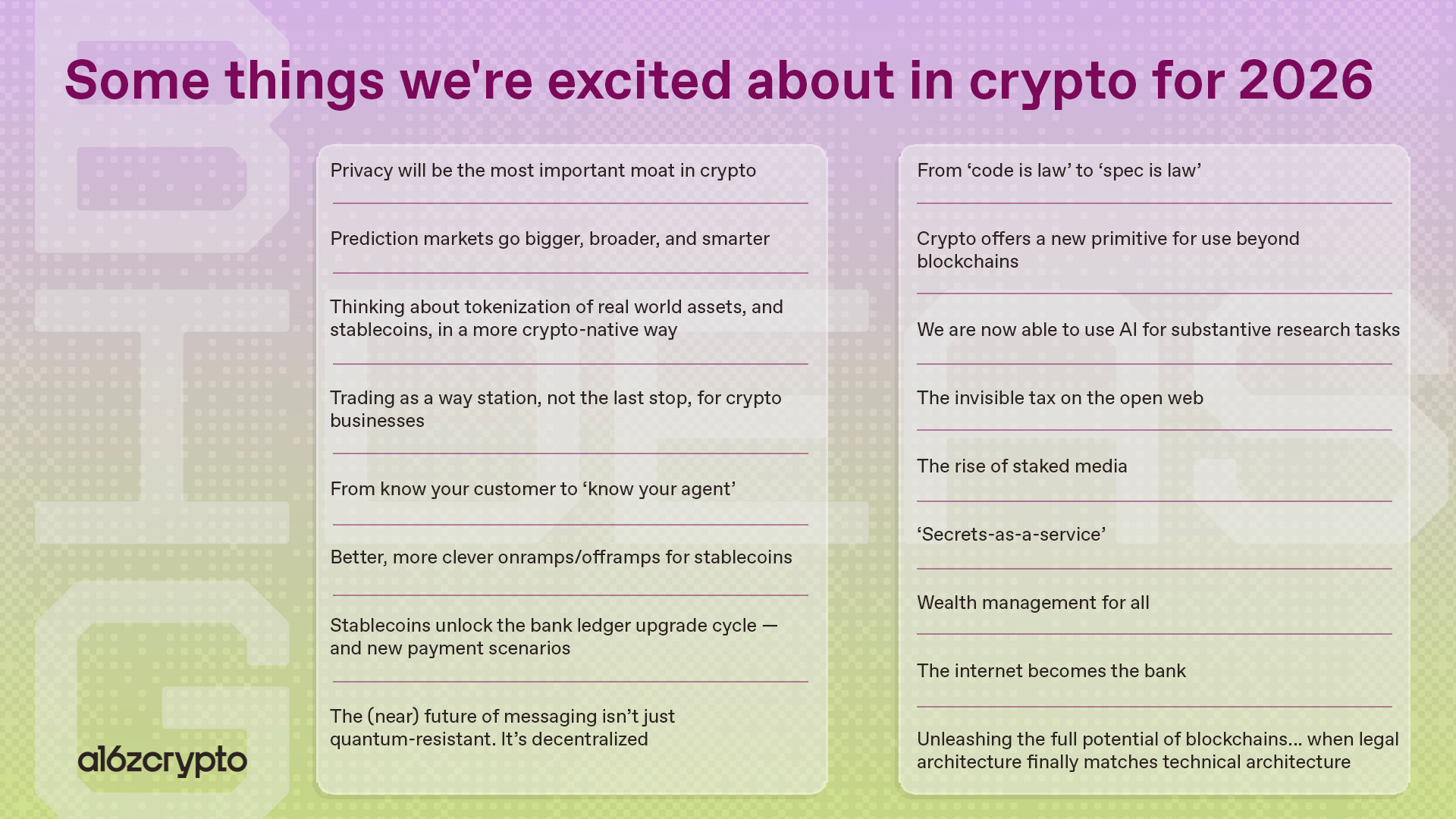
a16z「17 things we’re excited about for crypto in 2026」
Establishing a Smart Stablecoin Payment Network
The annual transaction volume of stablecoins will reach $46 trillion by 2025 (roughly three times that of Visa), and by 2026, advanced on/off ramps will be established that connect directly to national financial networks and QR payments, transforming the digital dollar into the foundational payment layer of the internet.
Crypto-Native Tokenization of Real-World Assets
While the on-chain tokenization of real-world assets like U.S. stocks and commodities advances, the trend extends beyond merely transplanting existing assets. Crypto-native synthetic asset methods, such as perpetual contracts (indefinite futures), are gaining traction. Notably, perpetual markets targeting emerging market equities are emerging.
Furthermore, stablecoins that become mainstream by 2025 will increasingly adopt a model where “issuance itself moves on-chain,” generating debt claims (origination) directly on the chain from the outset, rather than tokenizing off-chain loan receivables.
Upgrading Legacy Financial Systems
The overhaul of outdated banking core systems is progressing slowly, but by incorporating stablecoins and tokenized government bonds, banks can offer new functionality without a complete system replacement. 2026 will see traditional financial institutions further advance their adoption of cryptographic technology.
The Internet itself is becoming “bank-like”
In a world where AI agents autonomously trade behind the scenes, value transfers occur between systems rather than through human clicks. Value must move at the speed of information transmission. By 2026, mechanisms enabling agents to make instant, automatic payments for data and computational resources will begin to materialize, driven by the adoption of protocols like x402. Consequently, settlements become invisible network-level operations, and “banks” become part of the internet’s infrastructure.
Wealth Management for All
The democratization of asset management is advancing. Through tokenized assets and AI-driven portfolio optimization, individual investors can now access real-time, ultra-low-cost customized management.
KYA(Know Your Agent)
By 2026, as the AI agent economy gains full momentum, an infrastructure for “Agent Identity and Responsibility Verification” (KYA) will become essential—equivalent to KYC for humans. A system (KYA) will be established to provide agents with bank accounts and credit, using cryptographically signed certificates that link agents to their owners (entities) and constraints.
The AI-Driven R&D Revolution
By 2025, large-scale models will be rapidly adopted to support academic research, and by 2026, AI will be fully utilized for scientific discovery and problem-solving. Consequently, a trust infrastructure using blockchain technology—enabling data sharing and reward distribution for achievements—will be necessary for autonomous agents to collaborate and conduct research.
Countermeasures Against “Invisible Taxation” on the Open Web
AI agents are collecting content from the web and extracting value, creating an “invisible tax on the open web” that renders traditional advertising models dysfunctional. By 2026, new models—such as those automatically distributing micro-payments to content providers and next-generation sponsored content licensing models—will be explored and tested, advancing the development of web revenue infrastructure for the AI era.
Privacy is the ultimate competitive advantage.
Privacy protection is essential for driving global finance on-chain, and by 2026, privacy technology will be the most critical differentiator among blockchain chains. Some emerging L1s will accelerate efforts to emphasize transaction confidentiality by leveraging zero-knowledge proofs, aiming to lock in users through the “privacy network effect.”
Decentralization of Messaging and Quantum Resistance
Messaging apps will move away from centralized models, with decentralized, open-source communication protocols designed for the quantum computing era emerging by 2026. Messaging platforms like the Canton Network, involving major financial institutions, are being trialed globally. These platforms balance reliability and privacy, demonstrating potential to replace existing centralized messaging services.
“Secrets-as-a-Service”
The market for services that cryptographically control and share customer data and confidential information is emerging. Client-side encryption and distributed key management technologies for handling private data within smart contracts are advancing, driving progress in “service-oriented confidential information”—the provision of services that maintain data confidentiality behind AI and automated systems.
From “Code is Law” to “Specifications Are Law”
In response to the recent spate of DeFi protocol hacks, security is shifting from reactive measures—addressing issues after bugs are discovered—to proactive security. This involves defining formal specifications during protocol design and automatically rejecting deviating transactions. By 2026, strict “specifications” will be embedded into smart contracts, and designs that automatically detect and invalidate fraud unless broken will become commonplace (shifting from “code is law” to “specifications are law”).
Further Expansion and Advancement of Prediction Markets
2026 will be the year prediction markets take off. Prediction markets will be utilized in business and political decision-making, gaining attention as a risk hedging tool. Notably, AI integration will improve market prediction accuracy, and prediction market platforms will become mainstream as critical information discovery tools.
The Rise of Stake Media
A new media format emerges where content reliability is secured through staking on the blockchain. To combat the flood of AI-generated misinformation, a model where publishers themselves stake tokens to demonstrate information authenticity is gaining attention. Cryptographic tools that publicly verify content veracity also proliferate, and by 2026, media will see the emergence of a “token economy for trust.”
Off-Chain Use of SNARKs
The application of zero-knowledge proofs (SNARKs) is expanding beyond the blockchain domain, with ZK technology integrated into everyday apps by 2026. Consumer services will adopt ZK for data verification and computation while protecting user privacy, making this “blockchain-born” cryptographic technology the new privacy standard across IT.
Revenue Model Shift: From Trading to Core Business
Many crypto companies have traditionally relied on “token trading” and “exchange fees” as revenue sources, but by 2026, a clear shift will emerge toward competing based on core product value independent of trading revenue. As the market matures, trading will remain merely a stepping stone, and only companies that build products delivering long-term value to users are expected to survive.
Clarification of Regulations in the United States
By 2026, comprehensive cryptocurrency regulation by the U.S. government appears more realistic than ever, with congressional approval imminent. If enacted, it is expected to enhance transparency, establish clear industry standards, and bring an end to the current “regulatory Russian roulette” situation. Regulatory clarity will reduce uncertainty risks in the U.S. market and encourage the entry of major institutional investors.
Bitwise「The Year Ahead: 10 Crypto Predictions for 2026」
Bitcoin has completely broken its four-year cycle and set a new all-time high.
Position 2026 as the year the four-year cycle myth completely collapses. The halving-driven supply-demand model can no longer explain the market, and constant capital inflows via ETFs become the primary driver of price formation. Bitcoin transitions from a cyclical asset to an institutionalized financial asset.
